All posts
GeographyApril 23, 20268 min read read

How to Spot the Netherlands from Satellite Imagery: Polders, Canals, and the Most Engineered Landscape on Earth

The Netherlands has the most thoroughly engineered landscape on Earth — half the country is below sea level, the coastline is held back by an extraordinary network of dykes, and the polders form a geometric quilt visible from space. Here is the full guide.

How to Spot the Netherlands from Satellite Imagery: Polders, Canals, and the Most Engineered Landscape on Earth

The Netherlands is one of the most aerially distinctive countries on Earth, not because of any natural landscape but because of the extraordinary scale of human engineering applied to the land surface. Roughly 26 percent of the country is below sea level, and a further 29 percent is at risk of flooding. The Dutch response over the last 1,000 years has been to drain, embank, dyke, polder, and otherwise hydraulically engineer the country into existence. The result is a national landscape that no other country reproduces and that is unmistakable from satellite altitude.

For geography games, the Netherlands is one of the easier countries to learn because the aerial signature is so strong. This guide walks through the cues that lock it in fast and tell you where in the country you have landed.

Polders: A Country Designed on Graph Paper

The defining feature of the Dutch landscape is the polder — a tract of land reclaimed from the sea or from inland lakes, surrounded by dykes and drained by pumping stations. Polders are typically laid out in geometric rectangles with parallel drainage ditches at regular spacing — often every 50 to 150 metres — producing one of the most regular agricultural grids on Earth. From orbit, large parts of the Netherlands look like a vast piece of graph paper, with thin lines of canals and ditches dividing the country into rectangular green fields.

The largest polders are unmistakable. The Flevopolder and Noordoostpolder, reclaimed from the former Zuiderzee starting in the 1930s, together cover over 1,600 square kilometres of perfectly geometric agricultural land in the centre of the country. They are accessed by long straight bridges and have characteristic planned cities — Lelystad, Almere, Emmeloord — laid out in equally geometric patterns. Older polders in Holland and Friesland are less perfectly rectangular but still distinctly geometric, with the characteristic small fields, parallel ditches, and lines of grazing dairy cows visible at close zoom.

Dykes, Dams, and the Delta Works

Dutch dykes are visible from orbit as long straight or gently curved lines, often topped with roads and trees. The largest are unmistakable. The Afsluitdijk, a 32-kilometre-long barrier dam built in 1932 across the mouth of the Zuiderzee, converted the inland sea into the freshwater IJsselmeer and is one of the most recognisable engineering features in Europe. From orbit, it appears as a perfectly straight line cutting across the northern Netherlands, with characteristic locks and small ports along its length.

The Delta Works in the southwest is another extraordinary system, built after the 1953 flood disaster to protect the southwestern provinces. From orbit, you can see the storm surge barriers (Oosterscheldekering, Maeslantkering, Hartelkering), dams (Brouwersdam, Grevelingendam), and locks that together form one of the largest flood-defence systems on Earth. The combination of straight engineered dams, the resulting calm enclosed lagoons, and the distinctive geometric pattern of polders behind them is essentially unique to the Netherlands.

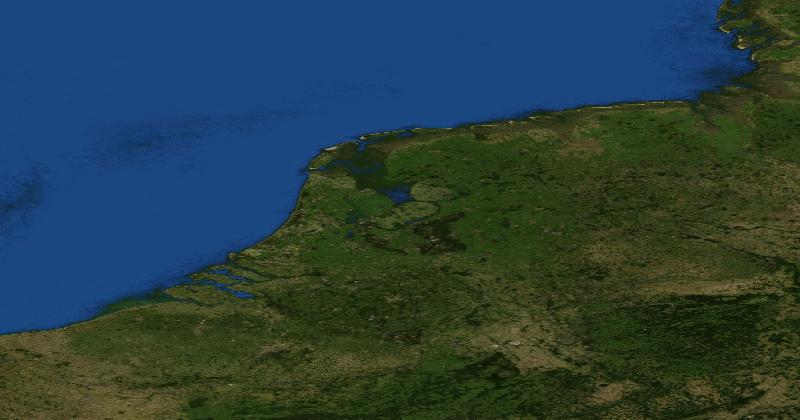
Dutch landscape with canals and tulip fields
The Netherlands' polders, canals, and dykes produce one of the most geometric aerial signatures on Earth.

Tulip Fields and Intensive Agriculture

Dutch agriculture is some of the most intensive in the world. The country is one of the largest agricultural exporters in the world despite its small size, producing flowers, vegetables, dairy, and meat in remarkable quantities. From orbit, several specific Dutch agricultural patterns are visible. The most photogenic are the tulip fields in the spring around Lisse, Hillegom, and the broader Bollenstreek — vivid stripes of red, pink, yellow, and orange visible from astronaut altitude during the brief flowering season.

Year-round, the Netherlands has the densest concentration of greenhouses on Earth. The Westland region between Rotterdam and The Hague is essentially one continuous greenhouse zone, with hundreds of square kilometres covered in glass roofs that reflect strongly from orbit. The Aalsmeer area south of Amsterdam is similarly greenhouse-dominated, with the world's largest flower auction. Outside the greenhouse zones, dairy pastures with characteristic black-and-white Holstein cattle, large rectangular fields of potatoes, sugar beet, and onions, and bulb fields produce a fine-grained agricultural mosaic across most of the country.

Dutch Cities and the Randstad

The Netherlands has roughly 17 million people in just 41,000 square kilometres, making it one of the most densely populated countries in Europe. Most of the population lives in the Randstad — the horseshoe-shaped urban region in the west of the country containing Amsterdam, Rotterdam, The Hague, Utrecht, and many smaller cities. From orbit, the Randstad appears as a more or less continuous urban area connected by motorways, rail lines, and canals, with a distinctive green heart (the Groene Hart) in the middle still preserved as farmland and meadow.

Individual Dutch cities have distinctive footprints. Amsterdam is unmistakable from orbit — the famous canal ring (Grachtengordel) curves around the historic centre in concentric semi-circles, the IJ waterway separates the centre from Amsterdam Noord, and the harbour extends west toward the North Sea. Rotterdam has the largest port in Europe, visible as an enormous industrial complex stretching west along the Nieuwe Waterweg. The Hague has its distinctive triangular layout with the Binnenhof and Mauritshuis in the centre. Utrecht has its medieval core with the Dom Tower visible. Maastricht in the south is more compact and historic, with a clearly different urban morphology reflecting its older Roman and medieval heritage.

Regional Tells

  • Holland (Noord and Zuid): the Randstad cities, polders, tulip fields, and the indented North Sea coast with characteristic long sandy beaches.
  • Zeeland: islands and peninsulas in the southwest, with the Delta Works providing the most dramatic engineering signatures.
  • Brabant and Limburg: more rolling terrain (the only part of the Netherlands with any meaningful elevation), with sandy soils, pine forests, and historic cities like 's-Hertogenbosch and Maastricht.
  • Flevoland: the planned post-war polders in the centre of the country, with geometric Lelystad and Almere visible.
  • Gelderland and Overijssel: rolling country in the east with the Veluwe national park (one of the largest forested areas in the country), sand dunes, and heaths.
  • Friesland: north of the IJsselmeer, with traditional Frisian terp villages, the Wadden Sea coast, and the Frisian Lakes inland.
  • Groningen and Drenthe: agricultural plains in the northeast, with the Wadden Sea coast and historic peat mining landscapes.

Where the Netherlands Gets Confused

The Netherlands is most often confused with Belgium (especially Flanders), parts of northern Germany (Lower Saxony), and Denmark. The disambiguators are usually specific: the density and regularity of canals and drainage ditches (highest in the world in the Netherlands), the prevalence of polders below sea level (essentially unique), the specific geometric patterns of bulb fields and tulip cultivation, and the characteristic Dutch farm and town styles. Belgian Flanders has similar density but lacks the polder geometry. Northern Germany has similar flat farmland but with less canal density and different field shapes. Denmark has similar dairy country but with more rolling terrain and fewer canals.

Pro-Tier Signals

Advanced players use finer details. The specific shape of Dutch farm clusters — long rectangular farmhouses with attached barns set in tiny garden plots between polders, with characteristic small drawbridges over the surrounding ditches. The pattern of Dutch motorways and bicycle path networks — the country has the densest cycling infrastructure on Earth, visible from orbit as parallel narrower paths beside major roads. The shape and density of Dutch wind turbines, both onshore and offshore in the North Sea wind farms. The characteristic terp villages of Friesland and Groningen, built on artificial mounds raised above sea level. The distinctive water-rich landscape of the Reeuwijkse Plassen and the Loosdrechtse Plassen — former peat-cutting areas now flooded into lake networks. And the specific patterns of Dutch container terminals at Rotterdam and Amsterdam, with their characteristic colourful container stacks visible at close zoom.

Practise It

The Netherlands is one of the easier countries to learn for geography games because the aerial signature is so unique. The polder geometry, the canals, the dykes, the greenhouses, and the bulb fields collectively produce a national fingerprint unlike anywhere else. Spend a focused session on EarthGuessr playing Dutch rounds and the country will quickly become one of the fastest first-second identifications in European play.

Series · Spot the Country

More from this series

View all in Spot the Country →

Ready to explore?

See the world from above and test your geography skills on a 3D globe.