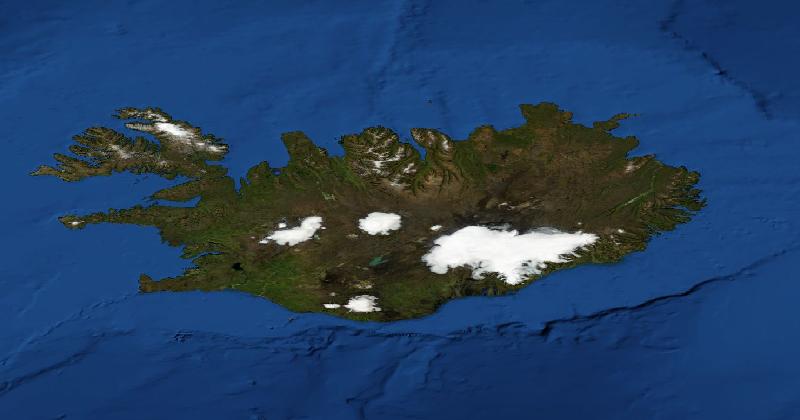
Iceland is one of the most aerially distinctive countries on Earth, partly because it is unlike anywhere else and partly because so little of it is covered in anything human. The country is small — 103,000 square kilometres, roughly the size of Kentucky — but it shows up in geography games more often than its size would suggest because the landscape is so recognisable. Volcanic plateaus, ice caps, lava fields, geothermal areas, and an almost entirely uninhabited interior produce satellite frames that no other country reproduces.
Iceland sits on the Mid-Atlantic Ridge, where the North American and Eurasian tectonic plates are pulling apart at a rate of roughly two centimetres per year. That makes it one of the most volcanically and tectonically active places on Earth, with eruptions occurring on average every three to five years. This guide walks through the cues that lock Iceland in fast and tell you which part of the island you have landed on.
Lava Fields and Volcanic Landscapes
The single most distinctive aerial signature of Iceland is the lava field. Roughly 11 percent of the country is covered in lava flows from the last 10,000 years, and another large fraction is covered in older basalt. From orbit, lava fields appear as dark grey to nearly black surfaces with distinctive textured patterns — ropy pahoehoe flows in some areas, blocky a'a in others. Some fields, like the vast Holuhraun flow from the 2014 eruption near Bárðarbunga, are clearly visible from astronaut altitude as black slashes across the highland interior.
Volcanoes themselves dot the country. Hekla, Katla, Bárðarbunga, Grímsvötn, Eyjafjallajökull, and Askja are the most active. Many are subglacial, buried under ice caps but visible from orbit by the distinctive cauldron-shaped depressions in the ice surface above them. Crater lakes, calderas, and lava domes are scattered through the interior. The colour palette of Iceland's volcanic terrain — black, grey, rust-red, and pale yellow where sulfur deposits cover the ground — is essentially unique among populated countries on Earth.
The Ice Caps
Roughly 11 percent of Iceland is covered in glaciers, and the four main ice caps — Vatnajökull, Langjökull, Hofsjökull, and Mýrdalsjökull — are visible from orbit as huge white masses dominating the central and southern interior. Vatnajökull alone covers 8 percent of the country and is the largest ice cap in Europe outside the Arctic, with characteristic outlet glaciers reaching down toward the south coast through dramatic moraine valleys. The pattern of large white ice masses surrounded by black volcanic terrain, with characteristic blue-green glacial rivers running south to the coast through pale silty floodplains, is essentially unique to Iceland in the world.
Glacier tongues from Vatnajökull descend toward the south coast, with characteristic dirty white surfaces full of moraine debris meeting the pale grey sandur (glacial outwash plain) below. The Skeiðarársandur and Mýrdalssandur are some of the largest active sandar in the world — vast flat plains of glacier-borne sediment cut by braided river systems, with very little vegetation and almost no settlement. The combination of ice cap, glacier tongues, sandar, and braided rivers is one of the strongest Icelandic signals.
The Ring Road and Icelandic Settlement
Iceland's population of roughly 390,000 is concentrated almost entirely along the coast. The interior highlands are essentially uninhabited — no permanent settlements, only a handful of summer huts and the F-roads (highland tracks) that thread through the lava fields and across the unbridged rivers. The Hringvegur (Ring Road), Iceland's Route 1, runs roughly 1,300 kilometres around the entire island in a single loop, visible from orbit as a thin grey line tracing the coast.
Reykjavík and its suburbs hold roughly two-thirds of the population. From orbit, Reykjavík has a distinctive footprint — a low-rise urban core wrapping the small Faxaflói bay, with characteristic red, blue, and white roof colours, geothermal heating infrastructure visible as steaming plumes from district heating stations, and the suburb of Mosfellsbær extending northward. Outside Reykjavík, the towns are small: Akureyri in the north (population 19,000) sits at the head of the long Eyjafjörður; Egilsstaðir in the east; Höfn near Vatnajökull's southern edge; Vestmannaeyjar on a volcanic island off the south coast; Ísafjörður in the Westfjords. The pattern of one small grouping every 50 to 100 kilometres along the coast, with nothing in between, is distinctive in itself.
The Westfjords, the Coastlines, and Sea Stacks
The Westfjords (Vestfirðir) in northwest Iceland are one of the most rugged and least-populated parts of the country. From orbit, they appear as a finger-like peninsula deeply cut by multiple long, narrow fjords with steep tabletop mountains between them — a more compact and more dramatic version of Norway's fjord coast. The Westfjords are connected to the rest of Iceland by a narrow isthmus, and from satellite altitude they look like a separate small island.
Other coastal features are distinctive. The south coast is mostly straight sandur and basalt cliffs, with the famous black sand beaches near Vík and Reynisfjara visible from orbit. The Reykjanes Peninsula in the southwest is dominated by lava fields and has the Keflavík International Airport visible as a clear geometric pad in otherwise raw volcanic terrain. The north coast has fjords cutting deep inland (Eyjafjörður, Skagafjörður) and the long Tröllaskagi peninsula. The Snæfellsnes Peninsula in the west has the conical Snæfellsjökull volcano dominating its tip, visible as a distinctive single white cone surrounded by dark lava.
Regional Tells
- Southwest (Reykjanes, Reykjavík, Snæfellsnes): lava fields, the capital and its suburbs, geothermal plumes, and the Keflavík airport.
- South (Suðurland): farms on the narrow coastal plain, the Westman Islands, the sandar of Vatnajökull's outlet glaciers, and Jökulsárlón glacial lagoon.
- Highlands (Hálendi): uninhabited interior with lava fields, ice caps, hot springs (Landmannalaugar, Hveravellir), and the Sprengisandur and Kjölur F-roads.
- East (Austurland): smaller fjords cutting into a high plateau, Egilsstaðir, the deserts of the Mývatn region, and the eastern flanks of Vatnajökull.
- North (Norðurland): Akureyri and Eyjafjörður, Lake Mývatn with its surrounding volcanic features, Húsavík and the whale-watching coast, and the Askja and Krafla volcanic systems.
- Westfjords (Vestfirðir): finger-shaped peninsula with dramatic fjords, Ísafjörður, and almost no settlement outside the small fishing villages.
Where Iceland Gets Confused
Iceland is one of the easiest countries on Earth to identify from satellite imagery, and is rarely confused with anywhere else. The closest potential confusions are Greenland (much larger, mostly ice-covered, no road system), Svalbard (smaller, fully Arctic, no Ring Road), the Faroe Islands (much smaller, grassier, fewer lava fields), or Hawaii (similar volcanism but tropical vegetation and very different climate). The combination of lava fields, ice caps, the Ring Road, geothermal features, and the high-latitude lighting is essentially unique to Iceland.
Pro-Tier Signals
Advanced players use finer details. The colour and arrangement of Icelandic geothermal greenhouses — pale plastic-covered rectangles visible in small farms in the southern lowlands, heated by geothermal steam from the ground beneath. The shape of Icelandic farm clusters — typically a single farmhouse with a few outbuildings and a small horse paddock visible on a small flat patch of land between mountains and the sea. The distinctive blue waters of Iceland's geothermal pools and the Blue Lagoon, visible from orbit as bright turquoise patches in otherwise grey lava terrain. The pattern of moss-covered older lava (the Eldhraun flow has a distinctive bright green carpet of moss covering hundreds of square kilometres of older lava). And the specific shape of Icelandic harbours — small angular jetties with characteristic small boats and fish-drying racks visible at close zoom.
Practise It
Iceland is one of the easiest countries to learn for geography games. The lava-and-glacier signature is so distinctive that almost any frame of the country is a fast lock. Once you have studied the differences between the south coast sandar, the Westfjords, the highlands, and the urban Reykjavík area, you can not only call "Iceland" within a second but typically identify the specific region. EarthGuessr's Icelandic rounds are among the most visually rewarding in the game — few countries are as photogenic from above.