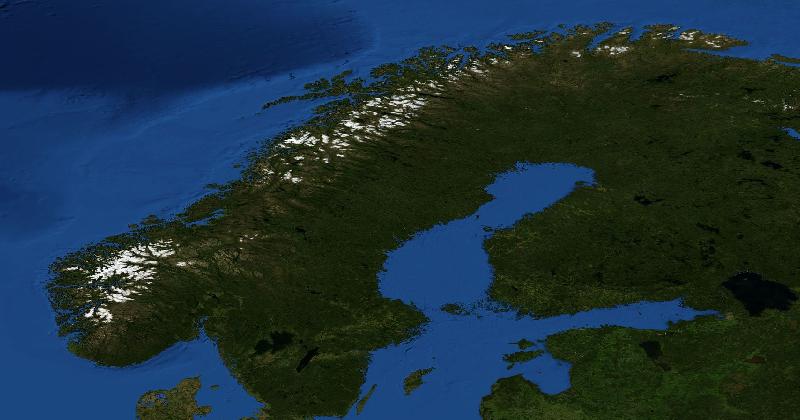
Norway has the longest and most complex coastline of any country in Europe, and arguably the most distinctive coastline on Earth. The mainland coast alone runs roughly 2,500 kilometres in a straight line from the southern tip to the Russian border — but if you include all the fjords, bays, and islands, the actual coastline length exceeds 100,000 kilometres. That ratio of indentation to direct distance is unmatched anywhere else in the world, and it produces an aerial signature that locks Norway in instantly.
Beyond the coastline, Norway has a high mountainous interior, vast plateaus, dense conifer forests in the south, and tundra and glaciers in the north. The country stretches from latitude 58° in the south (roughly the same as Edinburgh) to latitude 71° at the North Cape — far inside the Arctic Circle. That latitude range alone produces enormous variation in light, vegetation, and human activity visible from orbit. This guide walks through the cues that lock Norway in and tell you where on the long thin country you have landed.
Fjords: The Strongest Country-Identifying Signal in the World
Norwegian fjords are the result of millions of years of glacial erosion carving deep U-shaped valleys that the sea has since flooded. From orbit, they look like long, narrow, finger-shaped arms of seawater reaching tens or even hundreds of kilometres inland between near-vertical mountain walls. The Sognefjord — Norway's longest — extends 205 kilometres inland from the coast and is over 1,300 metres deep. The Hardangerfjord is the second-longest. The Geirangerfjord, the Nærøyfjord, and the Lysefjord are among the most photogenic. All of them appear from satellite altitude as bright blue thin slashes through textured green-and-grey mountain terrain.
Other countries have fjords — Chile, New Zealand, Greenland, Alaska, Canada, Scotland, and Iceland all have them — but Norway has them at a density and along a coastline so long that the country is essentially unmistakable. If a frame shows a coastline with multiple deep narrow fjords reaching inland, glaciated peaks visible in the background, scattered small settlements at the heads of fjords or on small islands offshore, and a distinct latitude shadow suggesting northern Europe, you are looking at Norway.
The Mountain Plateaus and Glaciers
Inland from the fjords, Norway rises into a series of high mountain plateaus — the Hardangervidda, the Dovrefjell, the Jotunheimen, and others. These are vast areas above the treeline with rolling tundra, scattered lakes, snow patches in summer, and a few hiking trails as the only human features. The Hardangervidda alone is the largest mountain plateau in Europe, roughly 8,000 square kilometres, and looks from orbit like a vast brown-green textured surface broken by hundreds of small lakes.
Norway has some of the largest glaciers in continental Europe. Jostedalsbreen, the largest, covers nearly 500 square kilometres and is clearly visible from satellite altitude as a brilliant white mass with characteristic glacier tongues reaching down into surrounding valleys. Folgefonna, Svartisen, and the glaciers of the Lyngen Alps in the north all have distinct aerial signatures. The combination of fjords plunging into the sea, plateaus rising above the treeline, and glaciers feeding rivers and waterfalls is essentially unique to Norway in Europe.
Norwegian Settlement Patterns
Norwegian settlements have a characteristic look from orbit. Almost all are small, with the largest cities (Oslo, Bergen, Trondheim, Stavanger, Tromsø) being modest by European standards. They cluster at the heads of fjords, along small coastal plains, or on the few flat areas in the interior. The architecture is distinctive — red, ochre, and white-painted wooden houses with steep roofs designed to shed snow, often visible from orbit as bright patches of colour against green or grey surroundings.
Oslo is the capital and largest city, sitting at the head of the Oslofjord in the south. From orbit, Oslo has a relatively small footprint by European-capital standards — a compact urban core surrounded by forested hills (the Marka), with the airport at Gardermoen visible to the north. Bergen on the west coast is wedged between mountains and the sea with its famous Bryggen waterfront. Trondheim sits at the head of a long fjord further north. Tromsø is on an island above the Arctic Circle and has a distinctive small-city footprint with the iconic Arctic Cathedral on the mainland side.
Lofoten, Vesterålen, and the Arctic North
Northern Norway has some of the most dramatic landscapes in the country. The Lofoten Islands are a chain of sharp, glacially carved peaks rising directly from the Norwegian Sea, with small fishing villages tucked into the few flat areas at the bases of the peaks. From orbit, Lofoten appears as a series of jagged dark peaks separated by narrow channels, with characteristic red and white fishing villages visible as bright spots. The Vesterålen islands to the north have a similar feel but with slightly more rounded peaks and broader valleys.
North of the Arctic Circle, Norway transitions to tundra and the great mountainous plateau of Finnmark. The North Cape (Nordkapp) sits at the northernmost tip of mainland Europe and is visible from orbit as a distinctive cliff jutting into the Barents Sea. Inland, the broad Finnmark plateau is the home of the Sami people and has a distinctive aerial signature of tundra, scattered lakes, and very few roads. Svalbard, the high-Arctic archipelago, is administratively part of Norway and is one of the most photogenic glaciated landscapes visible from orbit anywhere on Earth.
Regional Tells
- Southern Norway (Sørlandet, Østlandet): forested rolling country, gentle coast with skerries, the agricultural area around Oslo, and the dense forests of Telemark.
- Western Norway (Vestlandet): the great fjords (Sogn, Hardanger, Nord, Geirangerfjorden), Bergen, and dramatic mountain-and-sea coastline.
- Central Norway (Trøndelag): rolling hills, Trondheim, and the long Trondheimsfjord cutting east-west.
- Northern Norway (Nordland, Troms): the Lofoten and Vesterålen islands, the Lyngen Alps, and dramatic coastal mountains.
- Finnmark: tundra, the Finnmarksvidda plateau, Sami settlements, and the North Cape.
- Svalbard: glaciated Arctic islands, ice caps, and the small settlement of Longyearbyen.
Where Norway Gets Confused
Norway is most often confused with Chile, New Zealand, Iceland, Scotland, and the Pacific coast of Canada and Alaska — all of which share fjord coastlines and glaciated mountains. The disambiguators are usually specific. Chile's fjords are at southern latitudes and have evergreen southern beech forests rather than Norway's spruce and birch. New Zealand's fjords (in Fiordland) are more compact and concentrated in a smaller area. Iceland is more volcanic, with characteristic lava fields and lower mountains. Scottish lochs are smaller and not as deeply cut. The Pacific coast of Canada and Alaska has fjords but also dense temperate rainforest with massive trees, which Norway lacks at the same scale. Norwegian settlement style (red, white, and ochre wooden houses) and the proximity of distinctive cities (Bergen, Trondheim) when in frame are usually enough to confirm.
Pro-Tier Signals
Advanced players use finer details. The distinctive colour palette of Norwegian wooden houses (the red is faluröd, a deep oxide red, ochre is mustard-yellow, and white is brilliant). The pattern of Norwegian dairy farms — small operations with characteristic barns and silos at the heads of fjords or in valley bottoms. The signature of Norwegian hydroelectric infrastructure — dams, penstocks, and powerhouses tucked into mountains, often with characteristic rectangular reservoir lakes at high elevation. The shape and density of Norwegian salmon farming sea pens visible from orbit as clusters of circular structures in fjords. The Norwegian highway system with distinctive tunnels and bridges, the characteristic Hurtigruten coastal ferry route visible by its small ports along the coast, and the unique stave church wooden architecture visible in a few small villages. And the long shadows and characteristic vegetation of high-latitude landscapes in any frame.
Practise It
Norway is one of the most recognisable countries on Earth once you have studied the fjord coastline. The combination of long narrow sea-arms, glaciated mountains, distinctive wooden settlement architecture, and high-latitude lighting is essentially unique. Spend a focused session on EarthGuessr playing Norwegian rounds and the country will quickly become one of the most reliable identifications in your repertoire — and one of the most visually striking countries to study, since few satellite frames anywhere in the world are as photogenic as a Norwegian fjord.