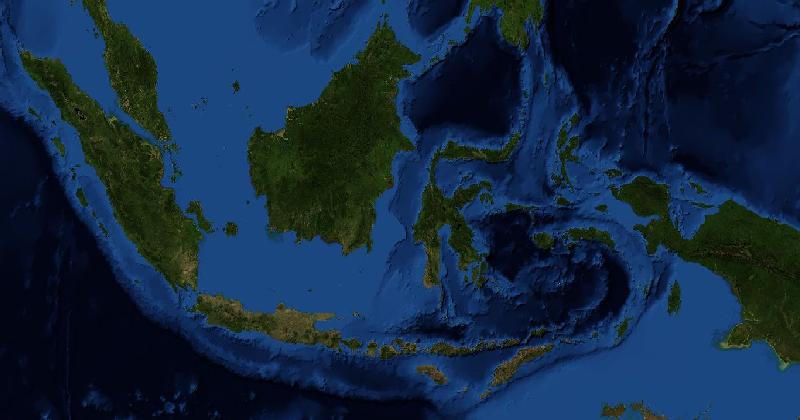
Indonesia is the largest island nation on Earth — more than 17,000 islands strung along the equator from the Indian Ocean to the western Pacific, spanning more than 5,000 kilometres east to west across three time zones. From orbit, the country has one of the most distinctive footprints of any nation: a long arc of tropical islands, many of them volcanic, almost all of them green, with characteristic coastline shapes, rice terrace patterns, and visible signs of one of the most active tectonic regions on Earth.
Identifying Indonesia from a satellite frame is usually straightforward once you have studied a few examples. The harder skill is regional disambiguation — telling Java from Sumatra from Sulawesi from Borneo at a glance. This guide walks through both.
The Volcanic Signature
Indonesia sits along the Pacific Ring of Fire and has more active volcanoes than any other country — roughly 130, with dozens currently active. From orbit, this means distinctive conical peaks visible across the major islands, often with characteristic crater lakes, sulphur-yellow vents, and ash plumes. Mount Bromo, Mount Merapi, Mount Tambora, and many others are visually iconic.
If a frame shows a tropical island landscape with a perfect volcanic cone rising out of dense green forest, surrounded by smaller cones and terraced fields, you are very likely in Indonesia. Java in particular has a near-continuous volcanic spine that is visible from medium altitude.
Rice Terraces: The Distinctive Curving Pattern
Indonesian rice cultivation produces some of the most distinctive aerial patterns on Earth. On flat lowlands, paddies appear as small rectangular flooded fields with intricate channel networks. On hillsides, particularly in Bali and parts of Java and Sumatra, rice is grown on stepped terraces that follow the contours of the land — producing the famous curving, scalloped patterns that have become Indonesian visual icons.
From orbit, a hilly tropical landscape covered in fine concentric green and brown bands following the slope contours is almost always Indonesia — and most often Bali. The closest visual cousins are Philippine rice terraces (also iconic but in slightly different layouts) and Vietnamese terraces (steeper, sharper contour lines).
Major Island Identification
- Java: long and narrow, dense volcanic spine, intensively cultivated, very high population density (the most populous island in the world), large cities along the north coast (Jakarta, Surabaya, Semarang).
- Sumatra: long and even larger than Java, with a volcanic spine along the western side, vast lowland rainforest and peat swamp to the east, and the famous Lake Toba (the largest volcanic crater lake on Earth) visible from orbit.
- Borneo (Kalimantan, the Indonesian part): low rolling forested terrain with massive river systems, extensive peat swamps and oil palm plantations, and notably no large volcanic peaks.
- Sulawesi: K-shaped island with mountainous interior, distinctive coastline with deep gulfs, fewer paddies than Java/Bali, more coffee and cacao agriculture.
- Bali: small, densely populated, intensely terraced, volcanic, with iconic rice landscapes and a heavily developed southern coast (Kuta, Seminyak, Nusa Dua).
- Papua (western New Guinea): very different from the rest — high mountains (the Maoke range reaches 4,884 m at Puncak Jaya), dense undisturbed rainforest, very few roads or settlements.
- Nusa Tenggara (Lombok, Sumbawa, Flores, etc.): smaller volcanic islands east of Bali, drier than Java, with grassland-and-forest mixes and famous landscapes like Komodo.
Coastlines and Coral
Indonesian coastlines are complex, with thousands of small islands, mangrove-fringed estuaries, and coral reef systems visible as bright turquoise patches in the surrounding sea. The Banda Sea and Raja Ampat in eastern Indonesia have some of the most distinctive coral reef patterns on the planet. The southern coast of Java has long white sand beaches facing the Indian Ocean; the northern coast is more developed and more industrial.
If a frame shows a complex archipelagic coastline with dense tropical vegetation, multiple small offshore islands, and visible coral reefs in the surrounding water, you are almost certainly in Indonesia or possibly the Philippines.
Cities and Density
Indonesian cities are dense and have a characteristic look. Jakarta sprawls across the north coast of Java, with mid-rise development, dense informal settlements (kampung) packed along rivers, and a distinctive lack of large parks. Surabaya, Bandung, Medan, and other major cities follow similar patterns. Smaller towns often centre on a mosque and a market, with surrounding paddy or plantation land.
Where Indonesia Gets Confused
Indonesia is most often confused with the Philippines (also an archipelagic nation in the same region), Malaysia (which shares the island of Borneo and has similar tropical patterns), and Papua New Guinea (the eastern half of New Guinea, immediately adjacent to Indonesian Papua). The clearest disambiguators are usually the road network style, the specific shape of rice terraces, the prevalence of mosques versus churches when visible, and the regional plantation patterns (Indonesia has more oil palm and rubber than the Philippines).
Practise the Big Islands First
The fastest way to lock in Indonesia is to study Java, Sumatra, and Bali first — they are the highest-probability locations within the country. Once you can confidently identify a Javanese rice landscape, a Sumatran rainforest, and a Balinese terrace pattern, the rest of the country falls into place. Indonesia rewards study because rounds are visually rich and the regional cues are sharp.