All posts
GeographyApril 19, 20267 min read read

How to Spot South Africa from Orbit: Veld, Sierras, and the Cape

South Africa has a distinctive aerial signature shaped by its varied terrain — high veld grasslands, the dramatic Drakensberg, fynbos-covered Cape mountains, and the country's unique township footprints. Here is how to identify it.

How to Spot South Africa from Orbit: Veld, Sierras, and the Cape

South Africa is geographically distinct from most of the African continent. The country sits at the southern tip of the continent, with a varied landscape that ranges from the high veld plateau in the interior to the dramatic Drakensberg escarpment, the unique fynbos vegetation of the Cape, and the semi-desert Karoo. From orbit, these landscapes combine with a unique urban form — apartheid-era spatial planning produced city layouts unlike anywhere else on Earth — to give South Africa a recognisable national fingerprint.

This guide walks through the visual signals of South Africa and how to identify the country quickly when it comes up in a satellite-imagery game.

The High Veld: A Vast Grassland Plateau

Most of South Africa's interior sits at elevation between 1,200 and 1,800 metres on the Highveld, a vast grassland plateau covering much of Gauteng, Mpumalanga, Free State, and parts of the Northern Cape. From orbit, the Highveld appears as a flat-to-gently-rolling pale yellow-brown landscape in the dry season and bright green in the wet season, with large geometric agricultural fields, scattered farm dams, and small towns connected by long straight roads.

Highveld agriculture has a recognisable style: maize fields (the staple crop) are large and rectangular, with characteristic clusters of trees marking individual farmsteads and small towns featuring a central church, a single main road, and surrounding rectangular street grids. The pattern is similar to American Great Plains farming in some ways but the scale, road density, and farmstead style are visibly different.

The Escarpment and the Drakensberg

The Highveld ends abruptly at the Great Escarpment — a steep drop of 1,000 to 2,000 metres that runs along much of the eastern and southern edge of the plateau. The Drakensberg mountains form the most dramatic section, with sheer cliffs, deep valleys, and characteristic flat-topped peaks. From orbit, the contrast between flat plateau, sharp escarpment edge, and steeply incised lowland is one of the most distinctive landforms in southern Africa.

When a frame shows a sudden transition from flat agricultural plateau to steep mountainous terrain with characteristic cliffs and deep gorges, you are almost certainly looking at the Great Escarpment in South Africa or Lesotho.

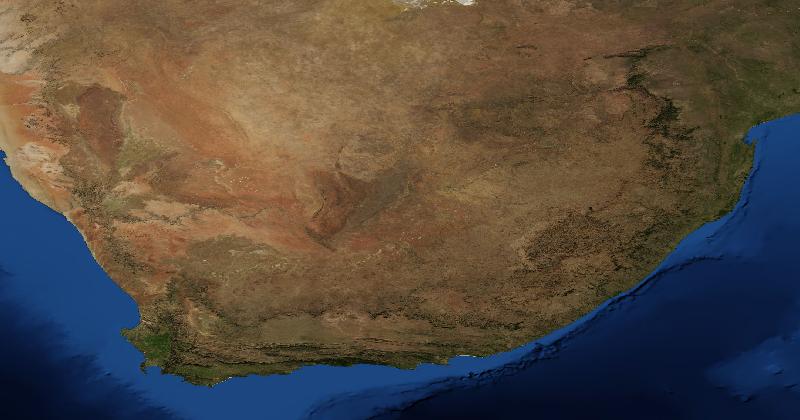
Aerial view of a varied southern African landscape
South Africa's combination of high plateau, steep escarpment, and distinctive urban form produces a national fingerprint with several immediately recognisable looks.

The Cape and Its Fynbos

The Western Cape has a Mediterranean climate and a unique vegetation type called fynbos — a shrubland of fine-leaved plants found almost nowhere else on Earth. From orbit, fynbos appears as a distinctive olive-grey-green texture covering steep mountain slopes around Cape Town, the Cape Peninsula, and stretching east along the southern coast. The combination of rugged peaks (Table Mountain, the Hottentots Holland, the Outeniqua), green vineyards in adjacent valleys, and turquoise coastal waters is one of the most photogenic on the continent.

Cape Town is itself visually iconic from orbit — the city sits on a peninsula dominated by Table Mountain, with the central CBD pressed against the harbour, and characteristic curving roads winding around the steep terrain. The image of the city with the flat-topped mountain visible behind it is one of the most recognisable urban frames in the southern hemisphere.

Cities and Townships

South African urban areas have a distinctive footprint shaped by apartheid-era spatial planning. The historic city centre and surrounding wealthier suburbs are well-treed, with curving streets and large lots. Beyond a clear demarcation line — often a railway, a highway, or a buffer of open land — sit the township areas, with smaller plots, tighter street grids, less tree cover, and a visibly different roof texture (more corrugated iron and small concrete houses, less large-roof villa-style development).

This pattern — formal city with green suburbs, a clear buffer, then large dense township areas with different infrastructure — is unique to South Africa and the surrounding Southern African region. It is one of the strongest urban-identification signals available, and it usually confirms the country immediately once you recognise it.

Regional Tells

  • KwaZulu-Natal: green subtropical coast, sugarcane plantations along the lowlands, dramatic terrain inland rising to the Drakensberg.
  • Western Cape: Mediterranean climate, vineyards, fynbos-covered mountains, the Cape Peninsula, the Garden Route along the south coast.
  • Eastern Cape: rolling hills, mixed grassland-and-shrubland, the Wild Coast.
  • Northern Cape: arid Karoo and Kalahari landscapes, large diamond and iron mining operations, very low population density.
  • Gauteng: Johannesburg and Pretoria, the country's economic heart, with the visible footprint of historic gold-mining operations (Witwatersrand) and dense urban sprawl.
  • Limpopo and Mpumalanga: bushveld, Kruger National Park, citrus and macadamia plantations, more tropical-feeling landscapes.

Where South Africa Gets Confused

South Africa is sometimes confused with Australia (similar veld-and-bushveld landscapes), Zimbabwe and Botswana (similar plateau and bushveld), Namibia (similar arid west), and parts of the southern United States. The clearest disambiguators are usually the apartheid-era urban footprint (very distinctive), the Drakensberg escarpment when visible, the Cape fynbos vegetation, and the specific style of rural farms (with characteristic farmsteads, dams, and fenced rangeland).

Practise the Three Big Looks

South Africa essentially has three big looks: Highveld farmland, Cape mountain-and-coast, and bushveld lowland. Studying each separately for a session or two will lock in South African identification rapidly. Once the township-edge pattern becomes automatic, the country becomes one of the easier southern hemisphere answers to call with confidence.

Series · Spot the Country

More from this series

View all in Spot the Country →

Ready to explore?

See the world from above and test your geography skills on a 3D globe.