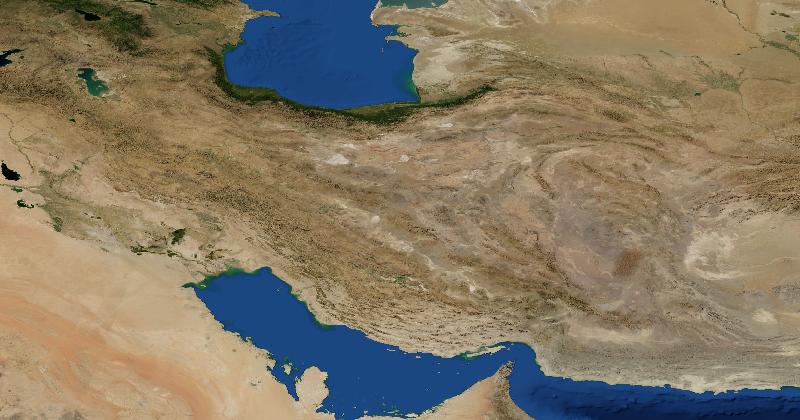
Iran is the second-largest country in the Middle East at 1.65 million square kilometres, with a population of 88 million spread across a remarkably varied terrain. The country is essentially a high plateau (averaging 1,200 metres elevation) bounded by mountain ranges on most sides: the Alborz running east-west along the Caspian coast, the Zagros running northwest-southeast along the western and southern borders, and the smaller ranges of Khorasan in the northeast. Within the high plateau lie two of the most extreme deserts on Earth — the Dasht-e Kavir and Dasht-e Lut — along with the agricultural oases that have supported Persian civilisation for thousands of years.
For geography games, Iran is a high-value country to learn because of its size, the strength of its regional aerial signatures, and the fact that it covers such a large area of the Middle East. This guide walks through the cues that lock Iran in and tell you where in the country you have landed.
The Zagros Mountains: One of the Most Dramatic Ranges in Asia
The Zagros Mountains run for roughly 1,600 kilometres along the western and southern edge of the Iranian plateau, from the Turkish-Armenian border in the northwest to the Strait of Hormuz in the southeast. From orbit, the Zagros are one of the most distinctive mountain ranges on Earth — a series of parallel ridges running northwest to southeast, with characteristic anticlines (folded sedimentary rocks producing long oval-shaped ridges) clearly visible from satellite altitude. The pattern is so geometric and so regular that the Zagros are one of the most-photographed mountain ranges from orbit and a classic example of fold-mountain topography in geology textbooks.
Many of the Zagros anticlines contain oil and gas, and Iran's southwestern oil fields are some of the largest on Earth. From orbit, you can see oil and gas infrastructure scattered through the Zagros foothills in Khuzestan, Bushehr, and Kohgiluyeh provinces: well pads, gas-oil separation plants, pipelines, and processing facilities. The combination of fold-mountain ridges and oil infrastructure is essentially unique to Iran and the immediately adjacent parts of Iraq.
The Dasht-e Kavir and Dasht-e Lut
The two great Iranian deserts dominate the eastern and central interior of the country. The Dasht-e Kavir (Great Salt Desert) in north-central Iran is roughly 80,000 square kilometres of salt flats, salt marshes, sand dunes, and dry lakebeds. From orbit, it appears as a vast expanse of pale tan and white, with distinctive salt-crust patterns and very little vegetation. The Dasht-e Lut further southeast is similarly large and contains some of the hottest surface temperatures ever recorded on Earth (over 70°C measured by satellite in some years). From orbit, the Lut has spectacular landforms: kalouts (long parallel wind-eroded ridges, also called yardangs), sand dune fields, and remote oases scattered through the otherwise empty terrain.
The combination of these two deserts means a huge fraction of Iran's interior appears from orbit as an empty, dry, brown-and-white landscape with very few features. But the oases that punctuate this emptiness are distinctive — small green patches with palm trees, mud-brick villages, qanats (ancient underground irrigation channels visible from orbit as long lines of small craters), and centre-pivot irrigation farms in more recent areas of agricultural development.
The Alborz Mountains and the Caspian Coast
Northern Iran is dominated by the Alborz mountain range, running east-west along the southern shore of the Caspian Sea. The Alborz contain the highest peak in Iran — Mount Damavand at 5,610 metres — a distinctive symmetrical volcanic cone visible from orbit as a single isolated white peak in the centre of the range. North of the Alborz, the Caspian coastal strip (the Gilan and Mazandaran provinces) is one of the wettest, lushest, and most surprising regions in the Middle East: subtropical, with dense forests, tea plantations, rice paddies, and a humid climate that produces aerial signatures unlike anywhere else in Iran.
The Caspian coast region appears from orbit as a thin strip of bright green agricultural land between the bright blue Caspian Sea to the north and the dark green forested Alborz to the south. Rice paddies dominate the lowlands, with characteristic flooded silver patches visible in spring and bright green ones in summer. Tea plantations cover the lower slopes. Cities like Rasht, Sari, Babol, and Gorgan are visible as moderately dense urban areas in the green strip. The contrast between the lush Caspian coast and the arid interior just south of the Alborz is one of the most dramatic regional contrasts visible in any Asian country.
Iranian Cities and the Persian Plateau
Iranian cities have distinctive aerial signatures. Tehran, the capital, sits at the southern foot of the Alborz mountains and has expanded enormously over the past 50 years. From orbit, Tehran appears as a huge urban area extending from the Alborz peaks in the north down across the dusty plain to the south, with the new Imam Khomeini International Airport visible far south of the city. The city has a characteristic pattern of dense Soviet-style apartment blocks in the centre, expanding to wealthier suburbs in the north (Niavaran, Tajrish, Shemiranat) and poorer suburbs in the south (Rey, Eslamshahr).
Esfahan in central Iran has a distinctive footprint with the central Naqsh-e Jahan Square (one of the largest historic squares in the world, visible from orbit) and the Zayandeh River flowing through. Mashhad in the northeast has the enormous shrine complex of Imam Reza at its centre. Shiraz in the southwest has the Persepolis archaeological site nearby and a distinctive layout against the Zagros foothills. Yazd in the central desert has a unique mud-brick old city with characteristic windcatchers (badgirs) visible from satellite altitude. Tabriz in the northwest has the largest covered bazaar in the world. And Qom, just south of Tehran, has the major shrine complex of Hazrat Masumeh.
Regional Tells
- Northwest (Azerbaijan, Ardabil): higher elevation with Mount Sahand and Mount Sabalan, Lake Urmia (now severely shrunken from its former extent), and a cooler climate.
- Caspian coast (Gilan, Mazandaran, Golestan): subtropical lowland with rice paddies, tea plantations, dense Hyrcanian forests, and the Caspian Sea to the north.
- Tehran and the central plateau: dense urban Tehran below the Alborz, the Qom and Kavir Salt Marshes east of the city, and the agricultural plains stretching south.
- West and southwest (Kurdistan, Kermanshah, Khuzestan): Zagros mountains, oil and gas infrastructure in Khuzestan, the marshes of southern Khuzestan, and characteristic Kurdish villages with stone walls.
- South (Bushehr, Hormozgan): Persian Gulf coast with distinctive ports, the volcanic islands of Hormuz and Qeshm, and the salt domes of the Zagros foothills.
- Central deserts (Yazd, Kerman, Semnan): the Dasht-e Kavir and Dasht-e Lut, ancient oasis cities, qanats, and characteristic mud-brick architecture.
- Northeast (Khorasan): the Kopet Dag mountains along the Turkmen border, Mashhad as a major urban centre, and saffron and pistachio agriculture.
Where Iran Gets Confused
Iran can be confused with Afghanistan, Iraq, Turkey, Turkmenistan, and parts of Pakistan or the southern former Soviet Union. The disambiguators are usually specific: the parallel fold ridges of the Zagros (uniquely Iranian at this scale), the characteristic Iranian mud-brick villages and old urban cores, the specific architecture of Iranian mosques (with bright blue tiled domes visible from orbit in many cities), the unique landscape of the Caspian coast, and the pattern of qanat-supported oases. Afghan and Pakistani landscapes are similar in places but tend to have different village styles and less developed infrastructure than equivalent Iranian areas.
Pro-Tier Signals
Advanced players use finer details. The characteristic blue-tiled domes of Iranian mosques and the elaborate geometric brickwork of historic Persian buildings, visible at close zoom. The pattern of qanats — long lines of small circular shafts visible from orbit, each shaft providing access to an underground irrigation tunnel running tens of kilometres from a mountain water source to a downhill oasis. The specific arrangement of Iranian gardens (the famous Persian charbagh pattern, visible in historic complexes like Fin Garden in Kashan and Eram Garden in Shiraz). The shape of windcatchers (badgirs) on traditional houses in Yazd and other desert cities. The pattern of Iranian oil refineries and petrochemical complexes, particularly the huge Pars Special Economic Energy Zone on the Persian Gulf. And the distinctive salt domes of the Zagros foothills, visible as roughly circular features in the surrounding folded terrain.
Practise It
Iran is one of the most rewarding Middle Eastern countries to learn for geography games. The Zagros, the central deserts, the Caspian coast, and the major cities each have signatures distinct enough to lock in fast. Spend a focused session on EarthGuessr playing Iranian rounds and the country will quickly become one of the more reliable identifications across western Asia — and the regional variety within Iran will let you narrow your guess to a specific region within a couple of seconds.