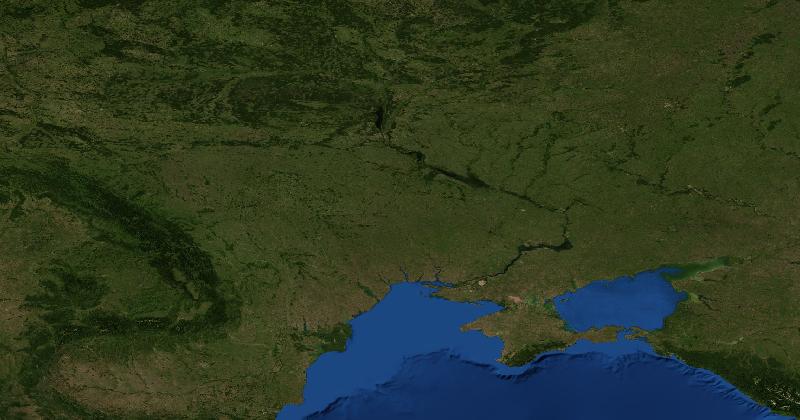
Ukraine is the second-largest country in Europe by area at 603,000 square kilometres (Russia being the first), and one of the most agriculturally productive places on Earth. Roughly two-thirds of the country is covered in chernozem — the famous black-earth soils that are among the most fertile in the world. That fertility, combined with a flat to gently rolling terrain, has produced an agricultural landscape on a scale matched only by the American Midwest, the Pampas of Argentina, and parts of northern China.
For geography games, Ukraine is a high-value country to learn because of its size, its frequency of appearance, and the strength of its regional aerial signatures. This guide walks through the cues that lock Ukraine in and tell you where in the country you have landed.
Black Earth and Huge Fields
The defining feature of Ukraine from orbit is the chernozem agricultural landscape — vast rectangular fields stretching to the horizon, in shades that vary dramatically through the year. After ploughing, the chernozem appears almost black from satellite altitude, an unusually dark colour for agricultural soil that is essentially unique to Ukraine, southern Russia, and the Hungarian and Romanian plains at this scale. In the growing season the fields turn green; in late summer they become golden as wheat ripens; in autumn they are again ploughed black; and in winter they may be lightly snow-covered, with the pale snow making the dark soil patches especially visible.
Ukrainian fields are typically much larger than fields in neighbouring countries to the west. Many are former Soviet collective farms (kolkhoz) that have been consolidated into corporate agricultural enterprises since independence, producing fields of 100 to 500 hectares — enormous by European standards. The pattern of these huge fields, often with shelterbelts of trees planted between them in long straight lines as Soviet-era wind erosion control, is one of the strongest Ukrainian signals available.
The Dnipro and the Other Rivers
The Dnipro (Dnieper in English transliteration) is one of the longest rivers in Europe, flowing from Belarus through Ukraine to the Black Sea — about 2,200 kilometres in total, with most of its length in Ukraine. The river is wide, gently curving, and dammed in multiple places creating a series of large reservoirs that are visible from orbit as long thin lakes following the river's course. The Kremenchuk Reservoir, the Kaniv Reservoir, the Kakhovka Reservoir, and others form a chain of artificial lakes that traces the Dnipro across central Ukraine.
The Dnipro divides Ukraine into a more forested and historically Polish/Lithuanian western half and a more open and historically Russian-influenced eastern half. The river is visible from orbit as a major curving feature, with cities and bridges marking key crossing points: Kyiv in the north, Cherkasy, Kremenchuk, Dnipro, Zaporizhzhia, and Kherson before the river reaches the Black Sea. Other major Ukrainian rivers — the Dnister flowing southwest to the Black Sea near Odesa, the Southern Buh, the Siverskyi Donets in the east — also produce visible signatures from satellite altitude.
The Carpathians and the Crimean Mountains
Most of Ukraine is flat, but there are two main mountainous areas. The Ukrainian Carpathians in the far west cover parts of Lviv, Ivano-Frankivsk, Zakarpattia, and Chernivtsi oblasts. They are part of the larger Carpathian arc that also runs through Slovakia, Poland, and Romania. From orbit, the Ukrainian Carpathians appear as a series of forested ridges running northwest to southeast, with characteristic wooden villages tucked into the valleys, traditional Carpathian sheep pasture (polonyna) on the higher slopes, and the highest peak — Hoverla at 2,061 metres — distinguishable as the centre of the highest ridge.
The Crimean Mountains run along the southern coast of the Crimean Peninsula, rising to roughly 1,500 metres and producing one of the most dramatic coastlines in the Black Sea region. The contrast between the dry steppe of central Crimea and the Mediterranean-style south coast (with subtropical vegetation, vineyards, and historic resort towns like Yalta, Alushta, and Foros) is one of the most striking regional contrasts within any European country.
Ukrainian Cities and the Industrial East
Ukrainian cities have distinctive aerial signatures. Kyiv, the capital, sits on both sides of the Dnipro with the historic core on hills above the right bank (the medieval Kyivan Rus core around St. Sophia, the Pechersk Lavra monastery, and the modern downtown around Maidan) and the more recently developed left bank suburbs (Troieshchyna, Darnytsia) on flatter terrain. The Kyiv Reservoir to the north and the Kaniv Reservoir to the south frame the city's river view. Several distinctive bridges cross the Dnipro within the city.
Other Ukrainian cities have their own signatures. Lviv in the west has a well-preserved medieval and Habsburg-era core visible from orbit, with the characteristic Polish-influenced Renaissance and Baroque urban morphology that distinguishes western Ukraine. Odesa on the Black Sea coast has a distinctive grid pattern reflecting its Catherine the Great-era planned origin, with the famous Potemkin Stairs descending to the port. Kharkiv in the northeast has a Soviet-era constructivist core. The eastern industrial cities — Donetsk, Mariupol, Dnipro, Zaporizhzhia, Kryvyi Rih — have characteristic large industrial complexes (steel mills, coal mines, machine-building plants), Soviet panel-housing suburbs, and frequently visible slag heaps and pit lakes from extractive industries.
Regional Tells
- Western Ukraine (Galicia, Volhynia, Transcarpathia, Bukovina): smaller fields, more forest, Polish-Lithuanian and Habsburg historical influence visible in town styles, and the Carpathian mountains in the south.
- Northern Ukraine (Polissia): forested and marshy, with the Pripyat marshes extending across the Belarusian border, sparse settlement, and the Chernobyl Exclusion Zone visible as an unusual patch of regenerating forest.
- Central Ukraine: huge chernozem fields, the Dnipro river system, and Kyiv at the northern end of the agricultural heartland.
- Eastern Ukraine: industrial cities, coal mines, steel mills, and the Donbas region's distinctive landscape of slag heaps and reservoir lakes.
- Southern Ukraine (Black Sea steppe): drier than the rest of the country, with sunflower and wheat dominating, irrigated cotton and rice along the lower Dnipro, and the Black Sea coast with characteristic lagoons (limans).
- Crimea: dry interior steppe, the southern coastal mountains, vineyards along the south coast, and the Sivash salt marshes connecting Crimea to the mainland.
Where Ukraine Gets Confused
Ukraine can be confused with southern Russia (especially Kuban and Stavropol regions), Belarus, Moldova, parts of Romania (Moldavia and Wallachia), Hungary, and Kazakhstan. The disambiguators are usually specific: the scale of agricultural fields (larger than in Belarus or Moldova, sometimes smaller than in Kazakhstan), the density of shelterbelts (highest in Ukraine and adjacent southern Russia), the specific village patterns with Ukrainian houses (often whitewashed with thatched or tile roofs in older areas), and the Cyrillic-language signage when visible. The Carpathian foothills of western Ukraine can be confused with Slovak or Romanian Carpathian areas, but Ukrainian village styles and Greek Catholic or Orthodox church architectures are distinctive.
Pro-Tier Signals
Advanced players use finer details. The specific shape of Ukrainian Orthodox churches (typically with multiple onion or bulbous domes in distinctive metallic colours — gold, blue, silver). The pattern of Soviet-era industrial infrastructure: standardised crane and warehouse layouts, the characteristic train-loading sidings of grain elevators, and the distinctive shape of Soviet-era kolkhoz farm centres (a cluster of brick or concrete buildings surrounded by huge fields). The pale yellow colour of harvested wheat fields and the bright yellow of sunflowers (Ukraine is one of the largest sunflower oil producers in the world) make for distinctive seasonal signatures. The shape of Ukrainian river ports and the long oil-and-gas pipeline networks crossing the country. And the specific colour of Ukrainian roads — older Soviet-era highways with characteristic concrete sections at expansion joints, newer highways with European-style asphalt.
Practise It
Ukraine is one of the most rewarding eastern European countries to learn for geography games because of its size, the strength of its agricultural signature, and the regional variety within its borders. Spend a focused session on EarthGuessr playing Ukrainian rounds and the country will quickly become one of the more reliable identifications in continental Europe. Within a few sessions, you will be calling not just "Ukraine" but "western Ukraine, probably Lviv region" or "central Ukraine, near the Dnipro" within a couple of seconds of seeing a frame.