All posts
GeographyApril 15, 20268 min read read

How to Spot South Korea from Satellite Imagery: Mountains, Rice Valleys, and Apartment Cities

South Korea has one of the most distinctive aerial signatures in Asia — densely packed apartment compounds, intensively cultivated rice valleys threading between mountains, and a coastline with thousands of small islands. Here is how to identify it from a satellite frame.

How to Spot South Korea from Satellite Imagery: Mountains, Rice Valleys, and Apartment Cities

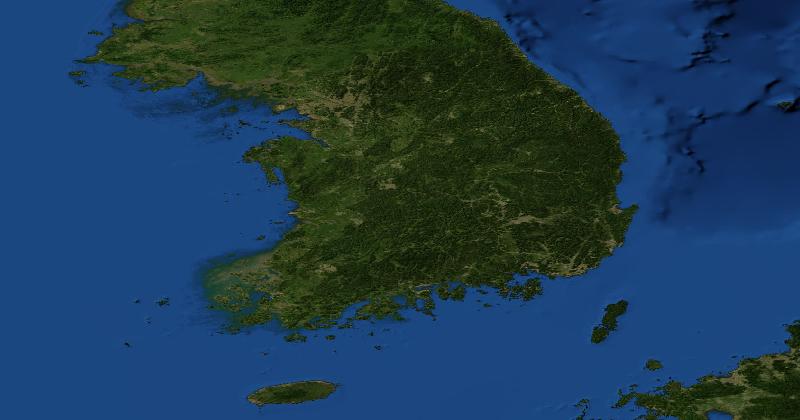
South Korea covers roughly 100,000 square kilometres — about the size of Iceland or Portugal — but contains over 51 million people, making it one of the most densely populated countries in the world. The country occupies the southern half of the Korean Peninsula, bounded by the Demilitarized Zone (DMZ) to the north, the Sea of Japan (East Sea) to the east, the Korea Strait to the south, and the Yellow Sea to the west. Roughly 70 percent of South Korea is mountainous, which forces population, agriculture, and industry into the lowland valleys and coastal plains, producing one of the highest population-density-in-usable-land figures on Earth.

For geography games, South Korea is one of the easier Asian countries to identify because the aerial signature is so distinctive. This guide walks through the cues that lock it in fast and tell you where in the country you have landed.

Rice Paddies in Steep Mountain Valleys

South Korea's rural landscape is dominated by rice cultivation in the relatively small lowland and valley areas. From orbit, this produces a distinctive aerial signature: bright silver flooded rice paddies in the spring, vivid green growing rice in summer, golden harvested fields in autumn, and pale tan ploughed fields in winter — all crammed into narrow valley floors with steep forested mountains rising abruptly on either side. The contrast between intensively cultivated, geometrically arranged paddies in the valleys and almost completely uncultivated forested mountains above them is one of the strongest Korean signals.

Korean rice paddies are typically small and irregular in shape, fitting the terrain, with characteristic terraced fields stepping up gentler slopes near the valley margins. Greenhouses are common, particularly in the southwest — large vinyl-house complexes visible from orbit as white reflective rectangular zones. Small villages with red, blue, and white-roofed houses are tucked between the paddies and the mountain footslopes. The pattern is most intense in Jeolla and Chungcheong provinces in the southwest and Gyeongsang provinces in the southeast.

Apartment Cities: A Korean Specialty

South Korean cities have an aerial signature unlike any other country except possibly parts of post-1990s China: enormous clusters of high-rise apartment compounds (apateu), typically 15 to 30 stories tall, arranged in tight regular blocks. The pattern began in the 1970s and 1980s as part of the country's rapid urbanisation and has continued to grow ever since. From orbit, Korean apartment compounds appear as dense clusters of tall identical buildings, often arranged in rows with similar spacing, producing a strikingly geometric urban texture.

Seoul and its satellite cities (Incheon, Suwon, Seongnam, Goyang, Bucheon, Anyang, Ansan, and others) form one of the largest contiguous urban areas in the world, with over 25 million people in the Seoul Capital Area. From orbit, the Seoul region is unmistakable — apartment compounds extend from horizon to horizon, divided by the Han River cutting east-west through the city centre, with the historic core around Gyeongbokgung Palace and Mount Namsan visible in the central north, and the dense southern districts of Gangnam south of the river. Busan in the southeast has a similar apartment-compound texture wrapped around mountainous terrain on the coast. Daegu, Daejeon, Gwangju, Ulsan, and other major cities all have similar patterns at smaller scales.

South Korean cityscape with mountains in background
South Korea's dense apartment compounds, intensively cultivated valleys, and mountainous interior produce a uniquely recognisable aerial signature.

The Coastline and the Thousand Islands

South Korea has one of the most island-rich coastlines in Asia. The west and south coasts are deeply indented with thousands of small islands — roughly 3,400 in total — most concentrated in the Jeollanam-do region in the southwest. From orbit, the southwestern coast looks like a scattered shower of small green dots in pale blue-grey water, with characteristic small fishing villages on most inhabited islands and ferry routes visible as wake patterns in the water. The Dadohaehaesang National Park covers a substantial portion of these islands.

The east coast is straighter and more dramatic, with the Taebaek Mountains rising abruptly from the Sea of Japan. Beaches along the east coast are characteristically long and straight, with characteristic Korean fishing ports tucked into bays. Cheju Island (Jeju-do) south of the peninsula is a volcanic island dominated by the shield volcano of Hallasan (1,950 metres), visible from orbit as a single round island with a central peak. The smaller volcanic islands of Ulleungdo and the disputed Dokdo lie further east in the Sea of Japan.

The DMZ and the Northern Border

The Demilitarized Zone separating South and North Korea is one of the most distinctive geographical features visible from orbit anywhere on Earth. The DMZ is roughly 250 kilometres long and 4 kilometres wide, running across the entire peninsula, and has been essentially undisturbed by human activity for over 70 years. From orbit, the DMZ appears as a stripe of unusually dense forest and natural vegetation running east-west across the peninsula, in sharp contrast to the intensively cultivated and urbanised landscapes on both sides. The border itself can sometimes be glimpsed as a thin line of cleared land, fences, and watchtowers.

Just south of the DMZ, the Korean side has agricultural land, scattered military bases, and the cities of Paju and Cheorwon. Just north, North Korea has a similar landscape but with notably different infrastructure — far fewer high-rise buildings, smaller fields, and a generally darker palette from less developed agriculture and infrastructure. The contrast between South Korean and North Korean landscapes at night, when South Korean cities blaze with lights and the North is almost entirely dark, is one of the most famous astronaut photographs ever taken.

Regional Tells

  • Seoul Capital Area (Gyeonggi-do): enormous urban region with the Han River, dense apartment compounds, Incheon airport on a reclaimed island, and the new town of Songdo.
  • Gangwon-do (northeast): mountainous, with the Taebaek range, ski resorts, the dramatic east coast, and the northern half of the DMZ.
  • Chungcheong (centre): agricultural plains, the city of Daejeon, the administrative city of Sejong, and the Geum River valley.
  • Jeolla (southwest): the most agricultural region with rice paddies dominating, the city of Gwangju, and the southwestern island-rich coast.
  • Gyeongsang (southeast): the historic Silla kingdom region, the city of Daegu inland, Busan and Ulsan on the coast, and the Nakdong River basin.
  • Jeju Island: volcanic island south of the peninsula with the Hallasan shield volcano, lava tubes, and a subtropical climate visible in palms and tangerine orchards.

Where South Korea Gets Confused

South Korea can be confused with Japan (especially Kyushu and the Inland Sea), North Korea, parts of southeast China, and Taiwan. The disambiguators are usually specific: the density of high-rise apartment compounds (uniquely Korean at this scale, with the closest comparison being newer Chinese megacity zones), the specific Korean village patterns with characteristic small rural housing, the absence of certain Japanese aerial signatures like Shinto torii gates or distinctive Japanese castle footprints, and the Korean road and motorway network with characteristic blue overhead signage. North Korean landscapes are similar in terrain but with very different infrastructure density and styling.

Pro-Tier Signals

Advanced players use finer details. The specific shape and arrangement of Korean apartment compounds, which typically include large parking lots, central play areas, and identical building rows — a pattern subtly different from Chinese or Japanese equivalents. The pattern of Korean Buddhist temples in mountains, often visible as small clusters of tile-roofed buildings nestled in dense forest. The characteristic Korean rural housing with distinctive blue or red metal roofs replacing the older tile roofs of traditional hanok houses. The shape and density of Korean greenhouses, particularly in Jeolla province and around Daegu. The signature of Korean industrial complexes — Ulsan's heavy industry zone is one of the largest industrial complexes in Asia and contains the world's largest Hyundai car factory, shipyards, and refineries. And the distinctive shape of Korean golf courses, which have proliferated in mountainous terrain and often have characteristic terracing visible from orbit.

Practise It

South Korea is one of the easier east Asian countries to learn for geography games. The combination of mountains and dense apartment cities is unique, and the regional differences within the country are sharp enough to enable fine-grained identification. Spend a focused session on EarthGuessr playing Korean rounds and the country will quickly become one of the more reliable identifications across Asia.

Series · Spot the Country

More from this series

View all in Spot the Country →

Ready to explore?

See the world from above and test your geography skills on a 3D globe.