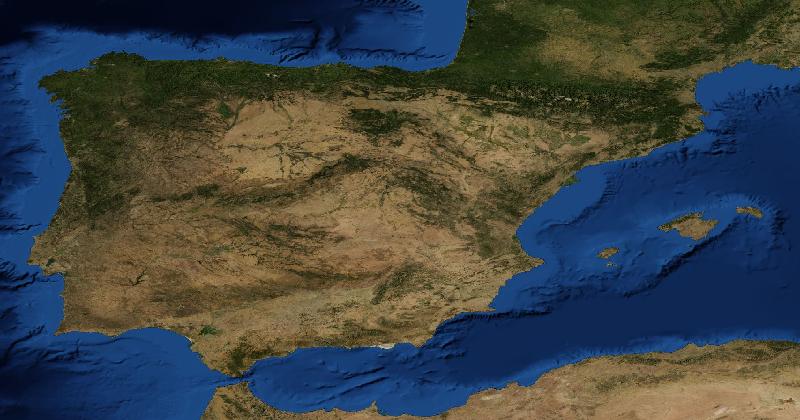
Spain is the second-largest country in the European Union by area at 505,000 square kilometres, and one of the most geographically varied. The Iberian Peninsula is essentially a high tilted plateau — the Meseta — bounded by mountains on every side and ringed by narrow coastal plains. That structure produces a sequence of distinct climate zones and agricultural patterns within a single country, from the green Atlantic north through the dry interior, the olive belt of Andalusia, and the irrigated huertas of the Mediterranean coast.
For geography games, Spain is a high-value country to learn — it shows up often, and each main region has a distinctive aerial signature. This guide breaks down the cues that lock Spain in within seconds and tell you which part of the country you have landed in.
The Meseta: A High Arid Plateau Like Few Others in Europe
The Meseta is the high central plateau of Spain — averaging around 600 metres elevation, covering most of Castile and León, Castilla-La Mancha, Madrid, and Extremadura. It is dry, treeless across most of its area, and dominated by extensive cereal agriculture, sheep pasture, and the famous dehesa landscape of scattered holm oak and cork oak above pasture. From orbit, the Meseta looks pale tan to pale green depending on season, with large rectangular fields, sparse vegetation, and very few towns.
The dehesa landscape in particular — savanna-like open pasture with widely spaced individual oaks — is a strong Spain signal. It looks like an African savanna transplanted to Europe, with the trees casting distinctive circular shadows over pale ground. The dehesa is the home of Iberian black pigs that produce jamón ibérico, and from orbit you can sometimes see the rectangular fenced enclosures with characteristic circular drinking troughs scattered among the oaks. No other European country has dehesa at this scale; the closest analogue is the montado in Portugal, just across the border.
Olive Country in Andalusia
Southern Spain is dominated by olive groves — in fact, Spain is the largest producer of olive oil in the world, and Andalusia alone has more olive trees than entire countries. From orbit, olive groves have a distinctive aerial signature: regularly spaced individual trees arranged in geometric grids, often on terraced hillsides. The colour is silver-green in summer, darker in winter, with the bare brown soil clearly visible between trees because olive groves are typically kept weed-free.
The province of Jaén alone has roughly 60 million olive trees covering most of the province in nearly unbroken groves. From orbit, looking at Jaén in summer is unmistakable: hundreds of square kilometres of regularly spaced silver-green dots arranged in lines, often draped over rolling hills, with small white villages scattered through the grove sea. Córdoba, Seville, Granada, and Málaga provinces have similar though less dense coverage. Other Mediterranean countries have olive groves — Italy, Greece, Turkey, Tunisia, Morocco — but Spain has them at a scale and density that locks in identification fast.
The Mediterranean Coast and the Huertas
The Spanish Mediterranean coast — Catalonia, Valencia, Murcia, Almería — has a completely different look from the interior. The huertas (irrigated coastal plains) around Valencia and Murcia are some of the most intensively cultivated landscapes in Europe, producing oranges, lemons, vegetables, and rice. The fields are small, geometric, and watered by ancient irrigation systems with origins going back to Roman and Moorish times. The rice paddies of the Albufera south of Valencia are some of the largest in Europe and produce the rice for paella.
Almería has one of the most surreal aerial signatures on Earth: an almost continuous sea of white plastic greenhouses covering roughly 30,000 hectares of the coastal plain. From orbit, the white plastic sheeting reflects sunlight so strongly that astronauts have reported it as one of the brightest single artificial features on the planet. Almería supplies a substantial fraction of Europe's winter vegetables and fruit, and the white sea of plastic is essentially impossible to mistake for anywhere else.
Northern Spain: Green Atlantic, Mountainous Pyrenees
Northern Spain looks nothing like the rest of the country. Galicia, Asturias, Cantabria, and the Basque Country are wet, green, and mountainous, with bocage-style small fields, eucalyptus and pine plantations on the hills, and a coast indented with rias — drowned river valleys similar in shape to fjords but less steep. The mountains of the Picos de Europa rise sharply from the coast, with glacial features and limestone karst. The Pyrenees along the French border are snow-capped much of the year, with high peaks and glacial lakes.
The northern Spanish coast is one of the easier coastlines to identify in Europe because of the ria pattern and the proximity of mountains. From orbit, the rugged green coastline with deep narrow inlets, mountains rising sharply behind, and small white-painted fishing villages tucked into bays is unmistakable. Inland, the Ebro Valley between the Pyrenees and the Cordillera Ibérica has its own dry character, with irrigated agriculture along the river and arid badlands above.
Spanish Cities and Pueblos Blancos
Spanish cities have distinctive aerial signatures. Madrid sits in the centre of the Meseta with the M-30 ring road clearly visible and the Castellana axis running north-south through the city centre. Barcelona has the famous geometric Eixample grid with diagonal avenues cutting across, the dense old quarter of Ciutat Vella by the port, and the unmistakable hill of Montjuïc. Seville is built on the inside of a bend of the Guadalquivir, with the Giralda tower and the historic Santa Cruz quarter clearly visible. Valencia is built around the dry bed of the Turia (turned into a long thin park) with the Mediterranean to the east.
Spanish pueblos blancos — the white-painted villages typical of Andalusia, Extremadura, and parts of Castile — have a distinctive look from orbit. They cluster on hilltops, often with a small fortress (alcázar) or church at the centre, and the white walls reflect strongly against the brown surrounding land. The pueblos blancos route through Cadiz and Málaga provinces is one of the most photographed driving routes in Spain, and many of the towns are visible from satellite altitude as bright white patches against tan hillsides.
Regional Tells
- Andalusia: olive groves stretching to the horizon, pueblos blancos, the Guadalquivir valley, and the Sierra Nevada visible to the south.
- Castile-La Mancha: open dry plains with windmills near Consuegra, large cereal fields, and the famous Don Quixote landscape.
- Castile and León: similar arid plateau with more relief, the Duero River running east-west, and historic cities like Salamanca, Segovia, and Valladolid.
- Extremadura: dehesa landscape with scattered oaks, sparse settlement, the Tagus and Guadiana rivers.
- Catalonia: more diverse landscape with the Pyrenees in the north, the Catalan Costa Brava, and the dense urban core around Barcelona.
- Valencia and Murcia: irrigated huertas, rice paddies, citrus orchards, and the Mediterranean coast.
- Galicia and the Basque Country: green, mountainous, ria-indented coast, and a much more humid landscape than the interior.
- The Balearic Islands: Mallorca's distinctive central plain ringed by mountains, Ibiza's small-scale terraced coast, Menorca's flat northern half.
- Canary Islands: volcanic, with the unmistakable cone of Teide on Tenerife dominating the central Atlantic frames.
Where Spain Gets Confused
Spain can be confused with Portugal, southern France, parts of Italy, Morocco (just across the strait), and Greece. The disambiguators are usually specific: olive grove density and village style for the south, dehesa for the interior west, huertas and greenhouses for the Mediterranean coast, and the ria-and-mountain pattern for the north. Portuguese landscapes have similar dehesa-like montado but with slightly different field patterns and town styles. Moroccan landscapes can resemble southern Spain but lack the European road infrastructure density. Italian and Greek landscapes have similar olive groves but with different surrounding terrain and village architecture.
Pro-Tier Signals
Advanced players use finer details. The specific colour and arrangement of Spanish bullring ovals visible in many small towns. The shape and density of Spanish autovía and autopista interchanges (Spanish motorways are often newer than French equivalents and have characteristic geometric patterns). The distinctive saffron-coloured roof tiles in central Spain versus the more orange tiles of Andalusia. The shape of windmills in La Mancha, the watch towers along the south coast (left over from Barbary pirate days), the characteristic almond and citrus orchard patterns near the coast, and the specific layout of Catalan masías (farmhouses) and Andalusian cortijos. The Spanish high-speed rail network, the AVE, is also visible from orbit as long straight viaducts running across the country.
Practise It
Spain is one of the most rewarding European countries to learn because of the variety within its borders and the frequency it appears in geography games. The Meseta, the olive belt, the Mediterranean coast, the green north, and the islands each have signatures distinct enough to lock in fast. Spend a focused session on EarthGuessr playing Spanish rounds and within a few sessions you will be able to call not just "Spain" but "Andalusia, probably Jaén province" within a second or two of seeing a frame.