All posts
GeographyApril 21, 20268 min read read

How to Spot Poland from Satellite Imagery: Strip Fields, Forests, and the Mazurian Lakes

Poland has one of the most distinctive agricultural landscapes in Europe — narrow strip-field patterns that look like nowhere else, vast pine forests, thousands of glacial lakes in the north, and a clear difference between the formerly German and historically Polish regions. Here is the full guide.

How to Spot Poland from Satellite Imagery: Strip Fields, Forests, and the Mazurian Lakes

Poland is one of the largest countries in central Europe at 312,000 square kilometres, sitting on the North European Plain that stretches from the Atlantic through France, Germany, Poland, and into Russia. The country is mostly flat — the average elevation is just 173 metres — but the surface is far from uniform. Poland has some of the most distinctive agricultural patterns in Europe, vast forests, thousands of glacial lakes, two mountain ranges in the south, and a coastline along the Baltic Sea.

For geography games, Poland is a high-value country to learn because of its size, its frequency of appearance, and the strength of its regional signatures. This guide walks through the cues that lock Poland in fast and tell you where in the country you have landed.

Strip Fields: One of the Most Distinctive Agricultural Patterns in Europe

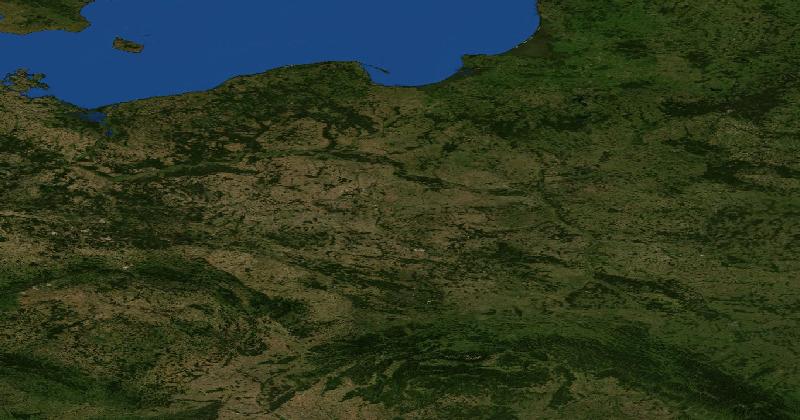
The single most distinctive aerial feature of much of rural Poland is the strip-field pattern. In large parts of the country, particularly in the historically Polish regions of Małopolska, Mazovia, Lublin, and Świętokrzyskie, agricultural land is divided into very long, very narrow strips — sometimes only 10 to 30 metres wide and a kilometre or more long. The pattern comes from the medieval system of land division that survived land reforms in Poland but was eliminated in most of western Europe centuries ago. From orbit, the strip-field pattern produces a distinctive striped texture across whole districts, in shades that vary by crop and season.

Western Poland — the regions of Pomerania, Lubusz, and Lower Silesia that were part of Germany before 1945 — has a completely different agricultural pattern, with larger rectangular fields more characteristic of central European agriculture. The boundary between the two patterns roughly traces the Oder-Neisse line and is one of the most visible historical signatures still imprinted on any European landscape. If a frame shows narrow strip fields in characteristic stripes, you are looking at historically Polish regions; if it shows larger rectangular fields, you are likely in formerly German territory.

The Mazurian Lakes and Northern Glacial Country

Northeastern Poland was heavily glaciated during the last ice age, and the result is a landscape of thousands of glacial lakes scattered across rolling moraine country. The Masurian Lake District (Pojezierze Mazurskie) is the most famous, with hundreds of lakes including Lake Śniardwy and Lake Mamry, but smaller lake districts exist throughout the north — Kashubian Lake District, Greater Polish Lake District, Pomeranian Lake District, and others. From orbit, this area looks distinctly different from southern Poland: dense forest cover, hundreds of irregularly-shaped lakes, sparse settlement, and very little arable agriculture.

The pattern is similar to parts of Finland, Sweden, or Belarus, but the lake density and distribution have a characteristically Polish-Baltic feel. The Suwałki area in the far northeast corner is one of the highest and coldest parts of the country, with rolling hills, scattered lakes, and small farms. The Mazurian and Suwałki lake regions together make up some of the most photogenic landscape in Poland and are easily identifiable from satellite altitude.

Polish countryside with strip fields and forest
Poland's narrow strip fields, vast pine forests, and Baltic glacial lakes produce distinctive regional aerial signatures.

Forests: One of the Most Wooded Plains in Europe

Roughly 30 percent of Poland is forested, much of it in dense pine plantations and natural mixed forests. Several enormous forest complexes are visible from orbit. The Białowieża Forest on the Belarusian border is one of the last remaining primeval forests of the European lowland and is visible as a dense dark green area straddling the international border. Białowieża alone covers about 1,500 square kilometres and is home to the largest population of European bison in the world.

Other large forests include the Bory Tucholskie in Pomerania, the Puszcza Notecka in western Poland, the Augustów Forest in the northeast, and the Piska Forest in Masuria. From orbit, Polish forests are typically dark green and geometrically arranged (most are planted pine forests with regular spacing and rectangular felling patterns), interspersed with smaller areas of mixed deciduous-conifer forest along rivers and on poor soils. The combination of large forest blocks and surrounding strip-field agriculture is one of the most characteristic Polish patterns.

The Mountains in the South

Southern Poland has two mountain ranges along its borders. The Tatras on the Slovak border are the highest in Poland, with Rysy at 2,499 metres being the country's highest peak. From orbit, the Tatras appear as a dramatic sharp glaciated range covering a relatively small area, with the resort town of Zakopane visible on the Polish side. The Sudetes along the Czech border are older, more rounded, and more wooded, with several distinctive areas like Karkonosze National Park, the Table Mountains (Góry Stołowe) with their sandstone plateaus, and the Snieżka peak.

Between the Tatras and the Sudetes, the Carpathian foothills and the Beskids form a wider mountainous belt across southern Poland. The Bieszczady in the southeast corner are particularly remote, with characteristic empty rolling mountain pasture (połoniny) where villages were depopulated after World War II. The Silesian and Małopolska uplands further north contain the Polish coal-mining heartland, with characteristic mining infrastructure and the dense urban region of Upper Silesia visible from orbit.

Polish Cities

Polish cities have distinctive footprints from orbit. Warsaw, the capital, sits on both banks of the Vistula in central Poland, with the historic centre on the west bank (rebuilt after near-total destruction in World War II) and the more modern districts of Praga on the east bank. The Palace of Culture and Science, the post-war Stalinist skyscraper, is visible as a distinctive landmark in the city centre. Kraków has a much better-preserved historic core, with the Wawel Castle on a hill overlooking the Vistula and the Old Town surrounded by the green Planty park ring where the medieval walls once stood.

Gdańsk in the north sits at the mouth of the Vistula with a distinctive port footprint and the historic Hanseatic core visible. Wrocław in the southwest has the characteristic island core (Ostrów Tumski) in the Oder river. Poznań sits on the Warta with the Old Market Square clearly visible. Łódź has its unique post-industrial fabric of textile factories visible from satellite altitude. And the Upper Silesian conurbation around Katowice forms one of the largest contiguous urban-industrial areas in central Europe.

Regional Tells

  • Pomerania and the Baltic coast: long sandy beaches, the Vistula and Szczecin lagoons, port cities Gdańsk and Szczecin, and the Hel and Słowiński peninsulas.
  • Masuria: rolling glacial country, hundreds of lakes, dense forests, and small Baltic-influenced villages.
  • Greater Poland (Wielkopolska): rolling agricultural country, the historic capital of Poznań, and the geometric fields of formerly German lands.
  • Mazovia and the Warsaw region: flat agricultural plains, strip fields, and the Vistula river running through.
  • Silesia (Górny Śląsk): dense urban-industrial conurbation around Katowice, with characteristic coal mines and steel works.
  • Lower Silesia (Dolny Śląsk): rolling country with the Sudetes mountains to the south, Wrocław in the centre, and historic Polish-German mixed heritage visible in town styles.
  • Małopolska: rolling country with strip fields, Kraków, the Tatras and Beskids to the south, and the Polish Jurassic Belt with its limestone outcrops.
  • Eastern borderlands (Podlaskie, Lublin, Subcarpathia): strip fields, Eastern Orthodox churches in places, the Białowieża and Augustów forests, and the Bieszczady mountains.

Where Poland Gets Confused

Poland can be confused with neighbouring countries: Germany (especially the eastern parts), Belarus, Ukraine, Lithuania, Slovakia, and the Czech Republic. The disambiguators are usually specific: the strip-field pattern (uniquely Polish at this density and scale, less common in Belarus and Ukraine), the boundary visible between strip-field east and rectangular-field west, the specific village patterns with characteristic linear settlements along single roads in many regions, and the road network density (higher than Belarus or Ukraine, lower than Germany). The Carpathian foothills can be confused with Slovak or Ukrainian Carpathian areas, but Polish villages have a distinctive style.

Pro-Tier Signals

Advanced players use finer details. The specific shape of Polish farmsteads (typically a linear arrangement with the house at the road, then the barn behind, then the fields stretching back from the road). The pattern of Polish villages — typically a single long road with houses on both sides for several kilometres (the famous Ulicówka pattern). The distinctive shape and colour of Polish wooden Orthodox churches in the east, the catholic baroque churches in the west and centre, and the characteristic wayside chapels and shrines at country crossroads. The pattern of post-war planned housing estates in Polish cities — large rectangular slab apartment blocks (the famous Wielka Płyta panel housing) visible in suburbs of every major city. And the specific signature of Polish military airfields, often preserved from communist days as long straight runways with characteristic dispersal pads.

Practise It

Poland is one of the most rewarding central European countries to learn for geography games. The strip-field pattern, the forest density, the lake-rich north, and the mountainous south each have distinctive signatures. Spend a focused session on EarthGuessr playing Polish rounds and the country will quickly become one of the more reliable identifications in European play — and the regional differences will sharpen, letting you call "eastern Poland, probably Lublin region" rather than just "Poland."

Series · Spot the Country

More from this series

View all in Spot the Country →

Ready to explore?

See the world from above and test your geography skills on a 3D globe.