All posts
GeographyMay 3, 20268 min read read

How to Spot Saudi Arabia from Satellite Imagery: Centre-Pivot Circles, the Empty Quarter, and the Hejaz

Saudi Arabia is the largest country in the Middle East and one of the most distinctive on Earth — vast sand seas, perfectly circular irrigation farms set in the desert, and a Red Sea coast like nowhere else. Here is how to identify it from orbit.

How to Spot Saudi Arabia from Satellite Imagery: Centre-Pivot Circles, the Empty Quarter, and the Hejaz

Saudi Arabia covers most of the Arabian Peninsula — 2.15 million square kilometres of mostly arid terrain stretching from the Red Sea in the west to the Persian Gulf in the east, from the borders of Jordan and Iraq in the north to Yemen and Oman in the south. The country contains some of the most extreme landscapes on Earth: the Rub' al Khali, also known as the Empty Quarter, is the largest contiguous sand desert on the planet; the Nafud and Dahna sand seas dominate the centre; and the Hejaz mountains rise sharply along the Red Sea coast.

For geography games, Saudi Arabia is one of the more distinctive countries to identify from orbit because of one specific signature that is essentially unique at scale: vast circles of irrigated farmland set in pure desert. This guide breaks down that and the other major Saudi aerial signatures.

Centre-Pivot Irrigation in the Desert

Saudi Arabia has built one of the most ambitious desert agricultural projects in history. Beginning in the 1980s, the kingdom pumped enormous quantities of fossil groundwater from deep aquifers to irrigate centre-pivot farms in the middle of true desert. From orbit, this produces one of the most surreal aerial sights on Earth: hundreds or thousands of perfect green or brown circles, each typically 50 hectares or larger, set in unbroken expanses of sand or gravel desert. Some clusters cover entire desert basins — in Wadi as-Sirhan, Hail, Tabuk, and Qassim provinces, the circles are visible in groups of dozens to hundreds per frame.

Other countries have centre-pivot irrigation — the United States, Australia, Libya, Egypt, Iran — but no country has them at the density of Saudi Arabia inside pure desert. The visual signal of dozens of perfectly geometric green circles set in featureless brown desert, with no surrounding agricultural landscape, no significant towns within frame, and often a network of straight roads connecting them to processing centres, is essentially unique to Saudi Arabia and a few neighbouring Gulf countries. Once you have seen the pattern, you can identify Saudi Arabia from a hundred kilometres of altitude.

The Empty Quarter and the Other Sand Seas

The Rub' al Khali — the Empty Quarter — covers roughly 650,000 square kilometres in southeastern Saudi Arabia, extending into Yemen, Oman, and the UAE. It is the largest contiguous sand desert on Earth, with dunes up to 250 metres tall arranged in long linear and star patterns. From orbit, the Empty Quarter looks like an unbroken sea of orange-red sand with distinctive dune patterns: long parallel linear dunes in the central section, complex star dunes in the southwest, and salt flats (sabkhas) in the eastern margins.

The Nafud and Dahna deserts in northern and central Saudi Arabia have their own distinctive dune patterns — smaller in extent than the Empty Quarter but still vast, with the Dahna in particular forming a long curved sand corridor connecting the Nafud to the Empty Quarter. The contrast between these red sand seas and the harder gravel and basalt deserts of the north and west is one of the strongest internal Saudi signals. If a frame shows orange-red linear dunes with no vegetation, no roads, and no human features for as far as the eye can see, you are almost certainly in the Empty Quarter or Nafud.

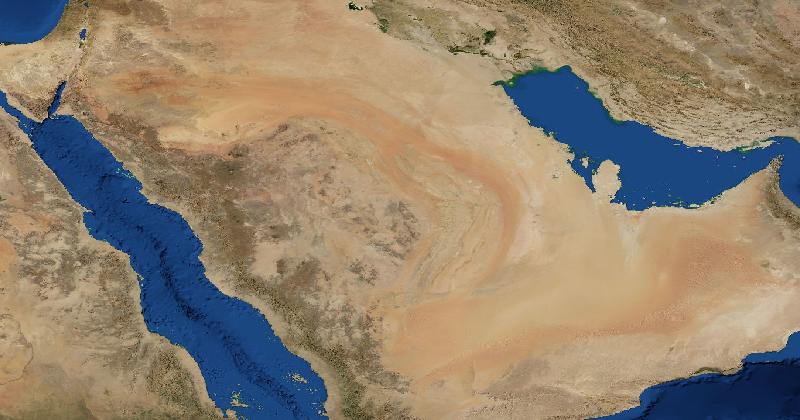
Saudi Arabian desert landscape with dunes
Saudi Arabia's centre-pivot circles set in pure desert, vast sand seas, and the dramatic Hejaz coast produce some of the most distinctive aerial signatures on Earth.

The Hejaz and the Red Sea Coast

Western Saudi Arabia along the Red Sea is dominated by the Hejaz Mountains, a long rugged range that rises sharply from the coastal plain to peaks over 3,000 metres. The mountains are stark, dramatic, and almost vegetation-free in most areas, with deep wadis (dry river canyons) cutting through them. The coastal plain (the Tihamah) is narrow, hot, and contains some of the holiest cities in Islam — Mecca and Medina, both visible from orbit as distinctive urban footprints set in otherwise sparse desert terrain.

Mecca in particular has an unmistakable aerial signature: the Grand Mosque (al-Masjid al-Haram) at the centre, the surrounding ring of high-rise hotels and infrastructure built to accommodate the millions of annual pilgrims, the Hira mountain to the north, and the broad valleys leading to the city from all directions. Medina has the Prophet's Mosque with its characteristic green dome and umbrella-shaded courtyards. Jeddah on the Red Sea coast is the largest city in the Hejaz, with a distinctive port footprint, the King Abdulaziz International Airport, and the new King Abdullah Economic City further north along the coast.

The Najd and Riyadh

Central Saudi Arabia is the Najd, the heartland from which the modern kingdom emerged. The terrain is high plateau, mostly arid, with scattered escarpments (the Tuwaiq Escarpment is the most prominent) running north-south. The capital, Riyadh, sits in the centre of the Najd and is one of the fastest-growing cities in the world by area — its sprawling rectangular footprint has more than doubled in the last 20 years, and from orbit you can see the characteristic grid of wide boulevards extending into the desert in every direction, the centre clustered around the Kingdom Centre and Al Faisaliah towers, and the new developments like the Diriyah heritage zone to the northwest.

Other Najdi cities have their own footprints: Buraidah and Unaizah in Qassim are surrounded by enormous centre-pivot circle clusters. Hail in the north has a distinctive low-rise sprawl backed by the Aja and Salma mountain ranges. Riyadh's wider region contains some of the most extensive new infrastructure projects in the kingdom — railway lines, motorways, and the King Salman International Airport under construction.

Regional Tells

  • Hejaz: dramatic mountains rising from the Red Sea coast, Mecca and Medina, the Tihamah coastal plain, and the volcanic harrat lava fields east of the mountains.
  • Najd: high arid plateau, Riyadh and its expanding sprawl, the Tuwaiq Escarpment, and scattered centre-pivot farms.
  • Qassim and Hail: dense clusters of centre-pivot circles, surrounded by sand and gravel desert, with Buraidah and Hail as regional centres.
  • Eastern Province: oil infrastructure including the Ghawar oil field (the largest conventional oil field on Earth) with characteristic well pads and pipeline networks, Dhahran and the King Fahd University of Petroleum and Minerals, Dammam and the Persian Gulf coast.
  • Empty Quarter: orange-red sand seas, no settlements, distinctive star and linear dune patterns.
  • Northern borders: gravel plains, smaller agricultural projects, and the Trans-Arabian Pipeline crossing into Jordan.
  • Southern mountains (Asir): higher elevation with juniper forests, traditional terraced farming, and the Abha highlands.

Where Saudi Arabia Gets Confused

Saudi Arabia is most often confused with its Gulf neighbours — the UAE, Kuwait, Oman, Qatar, Bahrain, and Yemen — all of which share similar desert landscapes. The disambiguators are usually scale (Saudi Arabia is by far the largest), the density and arrangement of centre-pivot circles (uniquely Saudi at the highest density in Qassim and Hail), the specific city patterns (Riyadh's distinctive rectangular grid is hard to mistake), and the Hejaz mountains and Red Sea coast which are essentially exclusively Saudi territory. Iranian Khuzestan has some similar oil-infrastructure landscapes across the Persian Gulf, but the road network and city styles are different. Egyptian Western Desert oases can resemble Saudi pivot farms but at smaller scale and with different surrounding terrain.

Pro-Tier Signals

Advanced players use finer details. The specific colour and arrangement of Saudi oil and gas infrastructure (well pads as small rectangular cleared areas, gathering pipelines as long straight lines, gas-oil separation plants as larger industrial complexes). The shape of Saudi mosques (typically with smaller domes and more austere architecture than Ottoman or Persian equivalents). The new mega-projects in the northwest — NEOM and the Line, which is being built as a 170-kilometre linear city across the Tabuk desert and is starting to be visible from orbit as a long straight construction line. The pattern of Bedouin camps and old qanat irrigation systems in the older oasis areas. And the specific pale yellow tone of Saudi urban roofs and the dense organisation of suburban compounds with characteristic walls and palm-tree courtyards.

Practise It

Saudi Arabia is one of the easier Middle Eastern countries to identify because of the centre-pivot signature alone. Once you have seen a cluster of green circles in pure desert, the country becomes a fast lock. Spend a focused session on EarthGuessr playing rounds in the Middle East and you will quickly internalise the differences between Saudi pivot country, the Empty Quarter, the Hejaz, and the urban footprints of Riyadh and Jeddah — and the country will become one of the more reliable identifications in any global rotation.

Series · Spot the Country

More from this series

View all in Spot the Country →

Ready to explore?

See the world from above and test your geography skills on a 3D globe.