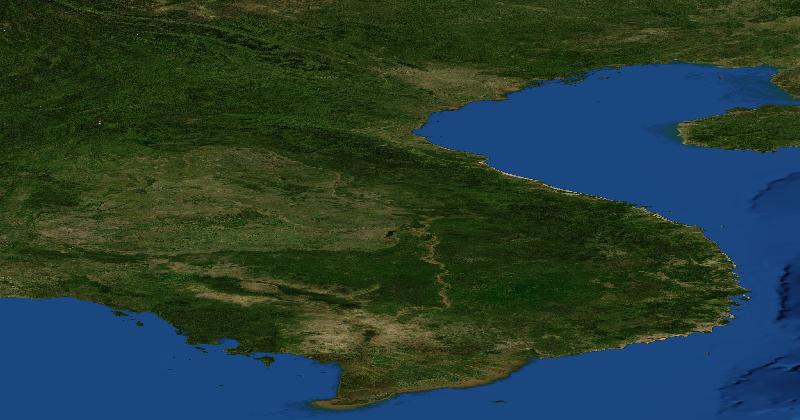
Vietnam stretches roughly 1,650 kilometres from the Chinese border in the north to the Cà Mau peninsula in the south — but at its narrowest point near Đồng Hới in the centre, the country is only 50 kilometres wide between the South China Sea and the Laotian border. That long thin S-curve, hugging the eastern edge of mainland Southeast Asia, is one of the most distinctive national shapes on Earth. If you can see enough of it in a satellite frame, the silhouette alone is a giveaway. But most frames show only a small patch of land, so this guide walks through the internal aerial signatures that lock Vietnam in.
Vietnam covers roughly 331,000 square kilometres and contains 98 million people, making it one of the densest large countries in Asia. Most of that population lives in the two rice deltas — the Red River Delta in the north around Hanoi, and the Mekong Delta in the south around Hồ Chí Minh City — with a thin strip of agriculture along the central coast and a much sparser population in the mountainous interior. Each region has a distinctive aerial signature.
The Mekong Delta: One of the Most Water-Dominated Landscapes on Earth
The Mekong Delta in southern Vietnam covers roughly 40,000 square kilometres and is one of the most aerially distinctive regions on the planet. The Mekong itself splits into nine main branches (the Vietnamese name Cửu Long literally means "Nine Dragons") before reaching the South China Sea, producing a vast fan of waterways, channels, and engineered canals. From orbit, the Mekong Delta looks like a watery green tapestry: bright green rice paddies in geometric patches, dense brown river channels, intricate canal networks, and characteristic floating settlements along the larger waterways.
The delta produces roughly half of Vietnam's rice and a substantial fraction of the world's rice exports. From orbit, you can see the seasonal floods that define the region — vast areas turn silver-blue during the wet season as paddies are flooded, then bright green as the rice grows, then golden as it ripens, then are sometimes flooded again as a second crop is planted. Aquaculture is also enormous in the delta, with shrimp and fish ponds visible as rectangular blue patches between rice fields, particularly in the coastal provinces of Cà Mau, Bạc Liêu, and Sóc Trăng. The combination of rice paddies, aquaculture ponds, and dense canal networks is one of the strongest Vietnam signals available.
The Red River Delta and the Northern Karst Country
Northern Vietnam's Red River Delta is smaller but equally distinctive. From orbit, it appears as a triangular plain of intensive rice cultivation, with the Red River and its tributaries winding through, and Hanoi at the centre. The pattern of paddies is denser and the field sizes smaller than the Mekong Delta, with many traditional villages still preserved in their pre-modern layouts — clusters of red-tile-roofed houses surrounded by bamboo, with rice paddies stretching out from each village in radial patterns.
North of the Red River Delta, the landscape transitions to one of the most spectacular karst regions on Earth. Ninh Bình and the surrounding provinces have a landscape of conical limestone karsts rising from flooded paddy plains — a landscape similar to Guilin in China but on the Vietnamese side. Further east, Hạ Long Bay and the adjacent Bái Tử Long Bay contain thousands of karst islands rising from emerald water, producing one of the most photographed coastlines in Asia. From orbit, the karst regions appear as dense clusters of small green-topped pillars in water or surrounded by rice paddies, with no other landscape on Earth quite matching the combination at this scale.
The Annamite Range and the Central Highlands
The interior of Vietnam is dominated by the Annamite Range (Trường Sơn), running roughly 1,100 kilometres along the western border with Laos and Cambodia. From orbit, the Annamites appear as a band of densely forested mountains, sparsely populated and crossed by only a few roads. The Central Highlands (Tây Nguyên) in the southern half of the range form a high plateau averaging 500 to 1,500 metres elevation, with characteristic red volcanic soils. Coffee plantations dominate the highlands — Vietnam is the second-largest coffee producer in the world after Brazil, and the highland coffee zones around Buôn Ma Thuột, Pleiku, and Đà Lạt are visible from orbit as rectangular patchworks of dark green plantation on reddish soil.
The mountain ethnic minority populations (Hmong, Tay, Thai, Muong, and dozens of others) live throughout the Vietnamese highlands and have characteristic terraced agriculture on hillsides — particularly the famous rice terraces around Sapa in the far north, which step up entire mountainsides in tight contour curves. From orbit, these areas have a distinctive textured aerial signature different from both the lowland deltas and the unmodified forest of the Annamites.
The Coast: 3,260 Kilometres of South China Sea
Vietnam's coastline runs for roughly 3,260 kilometres along the South China Sea, with a remarkable variety of beaches, bays, lagoons, and small offshore islands. The central coast from Đà Nẵng south through Nha Trang, Mũi Né, and Vũng Tàu has some of the most photogenic beaches in Asia — long white sand strands backed by coconut palms and dunes, with characteristic colourful fishing boats anchored in bays. The pattern of small Vietnamese fishing ports along the coast, each with characteristic small jetties and clusters of boats, is one of the more distinctive cues from satellite altitude.
Hạ Long Bay in the north and Phú Quốc Island in the southwest are the two most famous coastal landscapes. Hạ Long's karst islands are unmistakable. Phú Quốc, in the Gulf of Thailand, is a long thin island with a distinctive forested mountain spine, fishing villages along the coast, and the new airport and resort developments on the west side. Other offshore islands include Cat Ba, Cù Lao Chàm, Côn Đảo, and the Cham Islands.
Vietnamese Cities
Vietnam's three main urban areas have distinctive aerial signatures. Hanoi in the north has a compact historic core (the Old Quarter), the French colonial-era grid in the centre, and dense post-war and contemporary expansion to the west and south. The Red River and the Hoàn Kiếm Lake are visible in the city centre, and the new urban developments at Tây Hồ and the satellite cities to the north and west are clearly visible. Hồ Chí Minh City (formerly Saigon) in the south is the largest city in Vietnam, sprawling across both sides of the Saigon River with the colonial-era District 1 core, the new development of Thủ Thiêm across the river, and the new airport at Long Thành emerging east of the city. Đà Nẵng on the central coast is wedged between mountains and the South China Sea, with a long beach extending south.
Smaller Vietnamese cities — Huế (the imperial capital with the citadel visible from orbit), Nha Trang (a major resort city on the central coast), Hải Phòng (the main northern port), Cần Thơ (the largest city in the Mekong Delta) — have their own characteristic footprints. Vietnamese cities generally have a mix of dense low-rise traditional housing in older quarters and increasingly tall apartment compounds in newer developments.
Regional Tells
- Northern Highlands: dramatic mountains, terraced rice fields around Sapa, karst country in Hà Giang, and the Chinese border.
- Red River Delta: dense rice paddies, Hanoi, the karsts of Ninh Bình, and Hạ Long Bay to the east.
- North-Central Coast: narrow coastal plain, the Annamites rising sharply inland, the cities of Vinh and Đồng Hới, and the former DMZ at the 17th parallel.
- Central Coast: Đà Nẵng, Huế with its citadel, the Hai Van Pass mountains separating north and south climate zones, and the resort beaches of Hội An and Mũi Né.
- Central Highlands: high plateau with coffee plantations, red soils, indigenous minority villages, and the cities of Buôn Ma Thuột and Đà Lạt.
- Southeast: Hồ Chí Minh City and the rubber plantation belt to the north (Bình Phước, Tây Ninh, Đồng Nai).
- Mekong Delta: rice paddies, dense canal networks, aquaculture ponds, the floating markets, and the Cà Mau peninsula at the southern tip.
Where Vietnam Gets Confused
Vietnam can be confused with neighbouring Southeast Asian countries — Cambodia, Laos, Thailand, southern China, and parts of the Philippines or Indonesia. The disambiguators are usually specific: the unique long thin national shape (when visible), the density of the Mekong and Red River deltas (matched only by Bangladesh in scale), the specific Vietnamese village patterns with characteristic linear settlements along canals, the unique karst-and-paddy landscape of Ninh Bình, and the road network density (generally higher than Cambodia or Laos, comparable to Thailand). The terraced rice in northern Vietnam can be confused with Yunnan or Guangxi in southern China, but the village styles and surrounding agricultural patterns differ.
Pro-Tier Signals
Advanced players use finer details. The distinctive shape of Vietnamese tube houses (nhà ống) — extremely narrow but deep buildings squeezed into narrow plots, visible at close zoom particularly in older urban quarters. The pattern of Vietnamese floating villages on rivers and lakes, particularly in the Mekong Delta and on Tonlé Sap-influenced areas. The shape and density of Vietnamese aquaculture — both the rectangular shrimp ponds of the Mekong Delta and the floating fish-cage pontoons in larger rivers. The specific colour and arrangement of Vietnamese cemeteries — often visible as distinctive small grouped enclosures in the middle of rice paddies, with characteristic concrete tomb structures. The pattern of Vietnamese coffee processing infrastructure in the highlands. And the distinctive small boats (sampans, junks) anchored in nearly every Vietnamese harbour and river — at close zoom, the colourful boat clusters help confirm Vietnam over neighbouring countries.
Practise It
Vietnam is one of the most rewarding Southeast Asian countries to learn for geography games. The two deltas, the karst country, the Annamite spine, and the long coastline each have distinctive signatures. Spend a focused session on EarthGuessr playing Vietnamese rounds and the country will quickly become one of the more reliable identifications across the region — and the regional differences will let you narrow your guess to a specific part of Vietnam within a couple of seconds.