All posts
GeographyMay 5, 20268 min read read

How to Spot Turkey from Satellite Imagery: The Anatolian Plateau, the Black Sea Coast, and Cappadocia

Turkey straddles two continents and spans some of the most varied terrain in the eastern Mediterranean — the high Anatolian Plateau, the green Black Sea coast, the volcanic landscapes of Cappadocia, and the dramatic mountains of the east. Here is how to identify it from orbit.

How to Spot Turkey from Satellite Imagery: The Anatolian Plateau, the Black Sea Coast, and Cappadocia

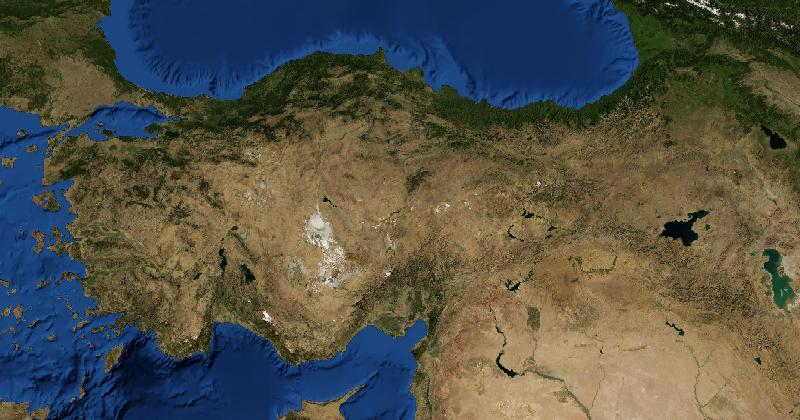
Turkey is the bridge between Europe and Asia, covering 783,000 square kilometres of varied terrain from the Aegean coast in the west to the high mountains of the Armenian border in the east. The country is split between the small European province of Thrace and the large Asian province of Anatolia by the Bosphorus and Dardanelles — two of the most strategically important waterways on Earth. The vast majority of Turkish territory is the Anatolian Plateau, a high arid interior bounded by the Pontic Mountains in the north along the Black Sea, the Taurus Mountains in the south along the Mediterranean, and the dramatic peaks of the east approaching Mount Ararat and the Caucasus.

For geography games, Turkey is a high-value country to learn because it shows up often and its regional landscapes are highly distinctive. This guide walks through the major aerial signatures and the cues that lock the country in fast.

The Anatolian Plateau: A High Arid Interior

Central Anatolia is a high arid plateau averaging 1,000 metres elevation, covering an area larger than the United Kingdom. From orbit, it looks pale brown to pale green depending on season, with large rectangular wheat and barley fields, scattered villages with mud-brick or stone houses and red-tile or flat roofs, and very few trees. The plateau is dominated by extensive dryland agriculture, with sheep and goat herding on the more arid areas and the famous salt lake of Tuz Gölü forming a vast pale gray patch in the centre.

Tuz Gölü itself is one of the most distinctive single features of central Turkey from orbit. It is the second-largest lake in the country, a shallow salt pan that mostly dries out in summer, leaving a vast white salt crust visible from astronaut altitude. Lake Beyşehir, Lake Eğirdir, and other smaller lakes scattered across the plateau add to the regional signature. The Konya Plain is one of the largest single agricultural areas in Turkey, with vast wheat fields stretching to the horizon and characteristic centre-pivot irrigation circles in the more recently developed areas.

Cappadocia: One of the Most Unique Landscapes on Earth

Cappadocia in central Turkey is one of the most distinctive landscapes visible from any satellite frame. The region was buried in volcanic ash from eruptions of Mount Erciyes and Mount Hasan millions of years ago. Erosion has carved the soft tuff into a forest of pinnacles, fairy chimneys, and conical rock formations — the famous Cappadocian landscape that draws millions of tourists every year. From orbit, the area appears as a pale tan landscape with strange textured patches where the rock formations are densest, interrupted by green valleys where small-scale agriculture is practised.

The surrounding terrain is volcanic — Mount Erciyes is one of the largest volcanoes in Turkey, with its broad symmetrical cone dominating the eastern side of Cappadocia, while Mount Hasan rises on the western side. Between them, the underground cities of Derinkuyu and Kaymaklı, the rock-cut churches of Göreme, and the unique hilltop towns of Uçhisar and Ürgüp are all visible from satellite altitude as distinctive clusters in an otherwise sparse landscape. The combination of volcanic peaks, tuff-eroded valleys, and small agricultural patches is uniquely Cappadocian and locks in Turkey instantly.

Turkish landscape with mountains and historical architecture
Turkey's mix of high arid plateau, volcanic landscapes, and coastal mountains produces some of the most varied aerial signatures in the eastern Mediterranean.

The Black Sea Coast and the Pontic Alps

Northern Turkey along the Black Sea is the wettest and greenest part of the country. The Pontic Mountains rise sharply from the coast to over 3,000 metres, capturing moisture from the Black Sea and producing one of the densest forest canopies in the Mediterranean basin. From orbit, the Black Sea coast looks like a thin strip of green agriculture (tea plantations, hazelnut groves, corn fields) backed by steep dark green forested mountains, with small port cities tucked into bays.

Turkey is the largest producer of hazelnuts in the world, and the hazelnut groves along the eastern Black Sea coast — particularly around Giresun, Ordu, and Trabzon — have a distinctive aerial signature: small rectangular groves planted on terraced slopes, with characteristic tree spacing and intensive small-scale management. Tea plantations near Rize have their own pattern of stepped terraces clinging to steep coastal slopes. The combination of intensely green steep slopes, terraced agriculture, and a narrow coastal strip is essentially unique to the Turkish and Georgian Black Sea coast.

The Mediterranean and Aegean Coasts

Turkey's southern and western coasts have a completely different feel — drier, with classic Mediterranean vegetation, olive groves, citrus orchards, and an indented coastline of bays, peninsulas, and offshore islands. The Aegean coast from Çanakkale down to Bodrum and Marmaris has hundreds of small islands, ancient ruins (Troy, Ephesus, Pergamon, Halicarnassus) visible from orbit, and a road network designed around the indented coastline. The Mediterranean coast from Antalya east to Alanya, Side, and beyond has long sandy beaches backed by the dramatic wall of the Taurus Mountains rising abruptly from the sea.

The Taurus Mountains themselves are one of the most distinctive aerial features in southern Turkey — a continuous limestone wall running parallel to the coast, with deep canyons, plateaus, and characteristic karst terrain. The pamukkale travertines near Denizli appear from orbit as a brilliant white patch on a hillside, with terraced pools of mineral-rich water creating one of the most photogenic single features in the country.

Eastern Anatolia and the Big Peaks

Eastern Turkey is mountainous, sparsely populated, and dramatic. Mount Ararat — at 5,137 metres, the tallest peak in Turkey — dominates the far eastern frames with its massive symmetrical cone, visible from orbit as a snow-capped giant rising from the surrounding plateau. Lake Van, the largest lake in Turkey, is a high-altitude saline lake nearly 1,700 metres above sea level with a distinctive elongated shape and striking blue colour. The mountains around it are part of the Armenian Highlands, and the landscape transitions to the dry plateaus of southeastern Anatolia toward the Syrian and Iraqi borders.

Southeastern Turkey, around Şanlıurfa, Gaziantep, and Mardin, looks like a continuation of the Mesopotamian plains, with intensive irrigated agriculture (the GAP project on the Tigris and Euphrates) producing distinctive green patches in otherwise arid terrain. Centre-pivot irrigation circles are common in this region, similar in appearance to those in the American Great Plains but at smaller scale.

Regional Tells

  • Marmara region: dense urban footprint of Istanbul straddling the Bosphorus, the Sea of Marmara visible to the south, and intensive agriculture in eastern Thrace.
  • Aegean coast: olive groves, citrus orchards, and the indented coastline with hundreds of small islands.
  • Mediterranean coast: long sandy beaches backed by the abrupt Taurus Mountains.
  • Central Anatolia: the high plateau, Lake Tuz, Cappadocia, and the volcanic peaks of Erciyes and Hasan.
  • Black Sea coast: green steep mountains, terraced hazelnut and tea plantations, and small port cities.
  • Eastern Anatolia: Mount Ararat, Lake Van, and the mountainous Armenian Highlands.
  • Southeastern Anatolia: irrigated cotton and pistachio plantations of the GAP project, the upper Tigris and Euphrates, and the basalt plateaus of Şanlıurfa.

Where Turkey Gets Confused

Turkey can be confused with Iran (similar arid plateau in places), Greece (similar Aegean and Mediterranean coasts), Syria (similar southeastern plateau), and parts of the Balkans for the European section. The disambiguators are usually specific: the unique tuff landscapes of Cappadocia, the distinctive Bosphorus and Dardanelles waterways, the specific minarets-and-domes style of Turkish mosque architecture visible in cities, and the distinctive coastal road infrastructure of the Turkish Mediterranean and Aegean. The Turkish road network is denser than Iranian equivalents and has different signage and road geometry.

Pro-Tier Signals

Advanced players use finer details. Turkish mosques have distinctive central domes with multiple smaller domes surrounding them and slim pencil-shaped minarets — the Ottoman mosque style is visible from orbit in city cores. Turkish village houses often have flat or low-pitched red-tile roofs with distinctive whitewashed walls in coastal regions. The pattern of Turkish agricultural greenhouses near Antalya is one of the densest greenhouse zones in Europe outside Almería. The shape and density of Turkish dam reservoirs (Atatürk Dam, Keban Dam, the dams of the GAP project) are visible as long branching lakes in the southeast. The specific colour and arrangement of Turkish tea factories along the Black Sea coast, the pomegranate orchards of the south, and the apricot orchards of Malatya are all regional micro-signatures.

Practise It

Turkey is one of the most rewarding countries to learn for geography games because of the variety of landscape and the frequency it appears. The Anatolian Plateau, Cappadocia, the Black Sea coast, the Aegean coast, the Mediterranean coast, the eastern mountains, and the southeastern plains each have signatures distinct enough to lock in fast. Spend a focused session on EarthGuessr playing Turkish rounds and the country will quickly become one of the more reliable identifications in the eastern Mediterranean.

Series · Spot the Country

More from this series

View all in Spot the Country →

Ready to explore?

See the world from above and test your geography skills on a 3D globe.